

The Voice Beneath the Voice
Anyone who has ever listened to a chimpanzee pant-hoot knows the sound lands oddly close to home. It is familiar yet alien, textured with bursts of breath and rhythm that seem to brush against the edges of speech without ever crossing into it. For decades, scientists have wondered whether the human brain still carries traces of an ancient sensitivity to primate calls. The question has lingered, partly because the human voice dominates our auditory world so completely that it is easy to assume our brains are built for us alone.
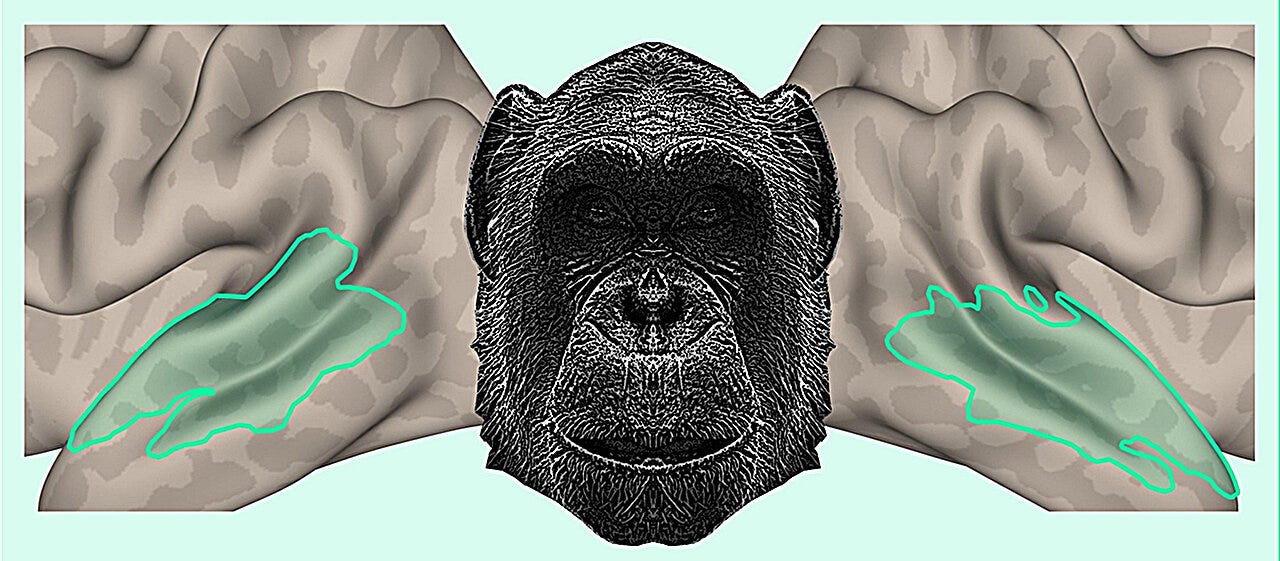
A new study1 led by Leonardo Ceravolo and colleagues at the University of Geneva complicates that picture. Their research suggests that parts of the human auditory cortex respond not only to the human voice but also to certain nonhuman primate vocalizations, particularly those that sit close to ours both evolutionarily and acoustically. In other words, the brains we carry today may still be shaped by the shared acoustic landscape that existed long before Homo sapiens found language.
“The auditory cortex appears to retain a sensitivity that long predates linguistic communication,” says Dr. Julia Markosian, an evolutionary neuroscientist at the Max Planck Institute for Human Cognitive and Brain Sciences. “Its architecture reflects millions of years of social listening among primates, not just the last hundred thousand years of human speech.”


