

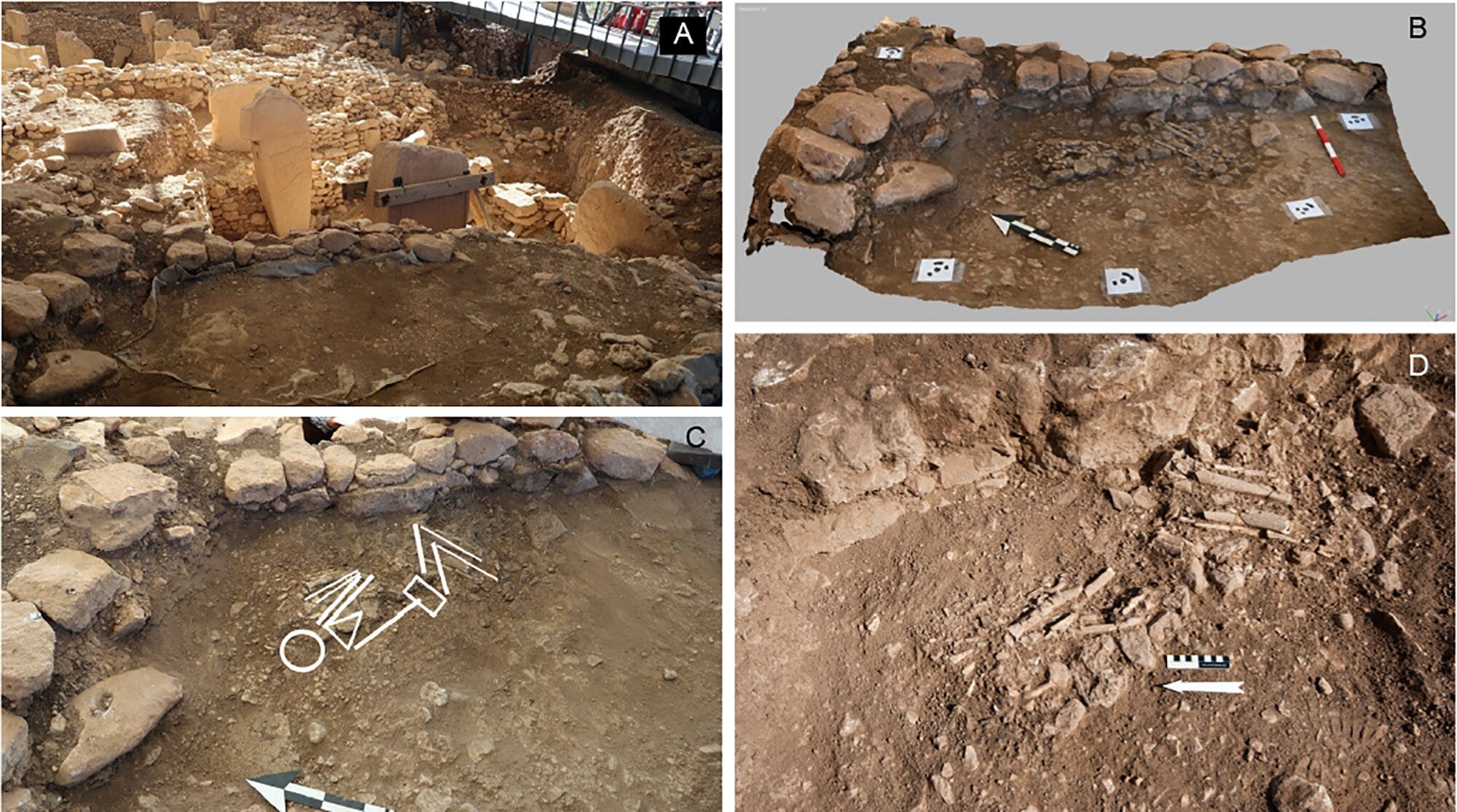
On the southeastern side of the mound at Göbeklitepe, workers digging a drainage channel in 2017 for the site’s new protective shelter came down on a pit cut into the plaster floor of a rectangular building, the first intact grave anyone had excavated at a place most of the world knows as a temple. The pit was roughly kidney-shaped and held the bones of at least three people, and those bones had been moved around inside it: the skulls gathered in the southeastern corner, most of the rest piled toward the middle, several long bones laid along the western wall.
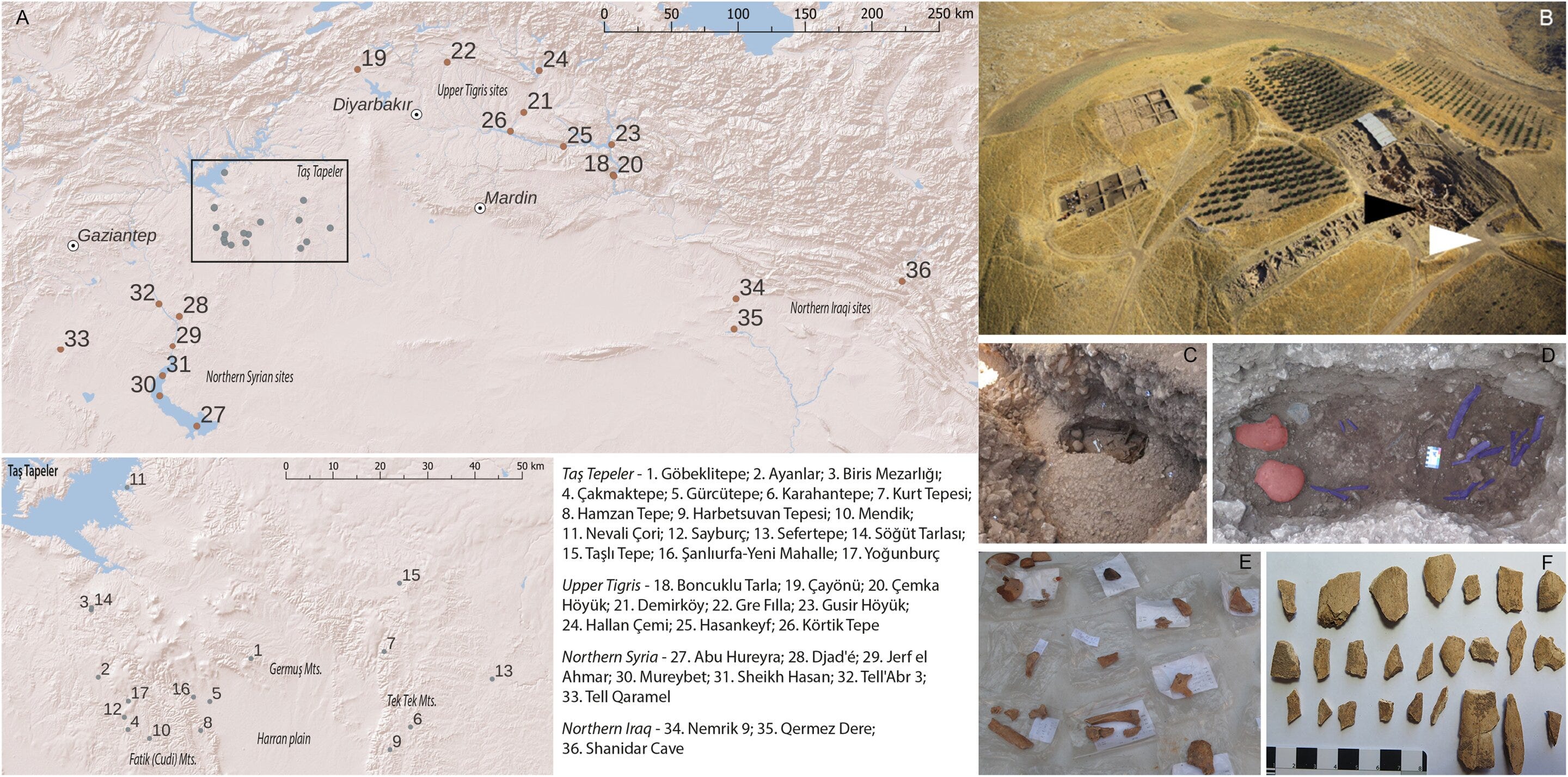
Göbeklitepe (the older two-word spelling, Göbekli Tepe, is still the more common one in English) lies 15 kilometers northeast of the city of Şanlıurfa in southeastern Türkiye, and for the first two decades after excavation began in 1995 it was described as a sanctuary: a place where hunter-gatherers came together to raise T-shaped pillars carved with wild animals, and where hardly anyone lived. Klaus Schmidt of the German Archaeological Institute (DAI), who led the excavation from its first season, called his 2006 book on the site Sie bauten die ersten Tempel, “They Built the First Temples.” In that picture, the human bone that kept turning up in the fill of the great pillared rooms was read, reasonably enough, as part of the ritual.
The count now stands at 928 fragments, not including the two graves, recovered from inside those rooms (the current team calls them special buildings) and from the ground between them. They come from men and women of every age, and some bear marks of deliberate handling. In June 2017, Julia Gresky, an osteologist at the DAI’s Division of Natural Sciences in Berlin and Georg-August University Göttingen who has run the analysis of the site’s human remains since 2009, published three skulls with deep grooves cut along the midline in Science Advances, reading them as evidence of a previously unknown form of Neolithic skull cult; human burials, that paper noted, were “still absent from the site.” Now she is lead author on a paper, published September 22 in PLOS One,1 arguing that much of the scattered bone reached the special buildings by accident. Gresky and her co-author, Lee Clare of the DAI’s Istanbul Department, propose that people living on the higher parts of the mound buried their dead beneath their own floors, as households did across Neolithic Anatolia and the Levant, and that the slopes later gave way and carried floors, rubble and bones down into the hollow where the special buildings stand.
Human bone was one of the few places where Göbeklitepe’s imagery, which includes a headless human figure on Pillar 43 in Special Building D, touched actual bodies. If most of the scatter is landslide debris, the physical case for ritual treatment of the dead shrinks toward a handful of carved skulls, and the settlement around the monuments starts to look like what recent seasons have suggested on other grounds, a place where people lived, died and were put under the floor. Telling a ritual deposit from a slide depends on taphonomy, the study of what happens to a body after death, and taphonomy needs a baseline. Until 2017 there was not a single excavated grave at the site to provide one.


