
The oldest known piece of birch tar from Europe comes from the site of Königsaue, Germany, and dates to somewhere between 80,000 and 40,000 years ago. It bears finger impressions. Someone was working it, kneading it, pressing it warm against a stone tool to bind a handle. That same someone almost certainly had birch tar on their hands and skin for the duration of the process, and probably long after.
That fact — the unavoidability of skin contact — is at the center of a new study by Tjaark Siemssen and colleagues published this month in PLOS One.1 The question they asked is one that seems obvious in retrospect: if birch tar is sticky enough to glue stone to wood, and if it coats the hands of anyone who produces it, what happens when it contacts bacteria in an open wound?
The answer, it turns out, is that it kills some of them.
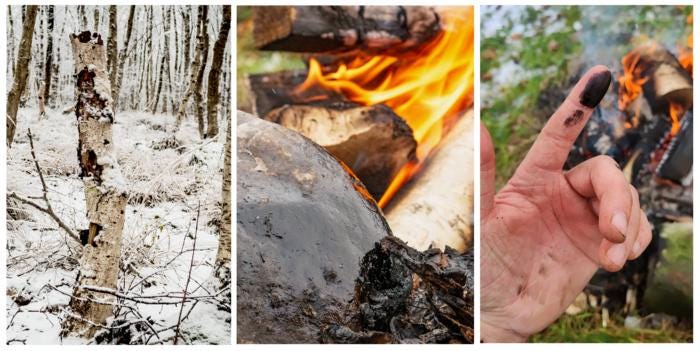
Siemssen and colleagues produced birch tar experimentally using bark from Betula pendula and Betula pubescens, the two birch species most well-documented in the European Late Pleistocene record. They used three production methods reconstructed from Middle Palaeolithic archaeological evidence: a condensation method, in which bark burns beneath a fireproof surface like stone and the tar is scraped off; a raised clay structure method, which is closer to what the Königsaue piece likely required; and a modern tin can method drawn from Mi’kmaq oral tradition. The samples were then tested against two bacterial strains using a modified Kirby-Bauer disc diffusion assay — the standard method for measuring antibiotic activity in clinical microbiology.
The results split cleanly. Against Staphylococcus aureus — a Gram-positive bacterium and the leading cause of skin and wound infections — birch tar produced measurable inhibition zones in five of six samples, ranging from 7.0 to 10.5mm. Against Escherichia coli, a Gram-negative bacterium, it did nothing at all. Zero inhibition across every sample. The tar is selective. It is not a broad-spectrum antibiotic. But S. aureus is exactly the bacterium you would want to suppress if you were applying something to a cut or abrasion, and birch tar suppresses it.
The selectivity is not surprising if you know why most plant-derived antimicrobials work the way they do. Birch tar contains phenolic derivatives — catechols, guaiacols, and related compounds — that can disrupt bacterial cell walls. Gram-positive bacteria like S. aureus are more vulnerable because their outer structure is a thick peptidoglycan layer that phenolic compounds can penetrate. Gram-negative bacteria like E. coli have an additional outer membrane that acts as a barrier, blocking entry. The tar’s chemistry is not sophisticated enough to overcome that barrier, but it doesn’t need to be. Wound infections caused by S. aureus are the relevant threat.
One of the study’s central findings is what did not matter: the production method. The team observed no clear relationship between how birch tar was made and how effective it was antibacterially. The condensation method, which yields the smallest amounts and has been theorized as the earliest technique Neanderthals might have used, produced tar with similar inhibitory activity to the more labor-intensive raised structure method. The most potent sample — inhibition zone of 10.5mm — came from the raised structure method using B. pendula bark. But other samples from the same method were less active, and a sample from the condensation method still suppressed S. aureus. Individual variation in bark chemistry and pyrolysis conditions matters more than the technique itself.
This has a direct implication for when medicinal use could have started. If antiseptic benefit is essentially method-independent, it would have been available to Neanderthals from the earliest phase of birch tar production, at minimum during Marine Isotope Stage 7 — roughly 191,000 to 243,000 years ago — when the earliest tar-hafted tools appear in the European record.
The Medicine You Couldn’t Avoid
There is something structurally different about this story compared to claims of deliberate Neanderthal medicine-making. Most of those arguments require inferring intent: a plant residue in dental calculus suggests it was consumed for its effects, but you cannot rule out incidental ingestion. The birch tar case is different. The team notes that during birch tar production, skin contamination is nearly inevitable regardless of technique, because the material is viscous and adhesive at working temperatures. You would have to make a deliberate effort to avoid contact. And the quantities needed for skin application are trivially small: approximately 0.2 grams is enough to cover 100 square centimeters of skin surface.
In other words, the wound-dressing dose is essentially the handling residue.
That does not mean Neanderthals understood what they were doing in any biochemical sense. But it does mean the beneficial effect was structurally available to anyone producing birch tar. If repeated contact with tar-coated skin consistently preceded faster healing of cuts and abrasions, that pattern could have been recognized and eventually formalized without requiring an explicit theory of infection. This is the kind of knowledge that ethnographic parallels suggest gets transmitted as practice, not explanation.
The L’nu (Mi’kmaq) people of Eastern Canada have used birch bark oil — known in Mi’kmaq as maskwio’mi — as a wound dressing and skin ointment for generations. Production knowledge has been passed down through oral tradition from Elders, and the method using tins was recently reconstructed by Bierenstiel and colleagues. Previous laboratory work on maskwio’mi produced from Betula papyrifera has shown broad-spectrum antibacterial properties, with inhibition zones against S. aureus reaching up to 20mm — considerably higher than the experimental Palaeolithic samples in this study, possibly because industrially produced extracts concentrate the active compounds. The Saami of Lapland and the Yakut of Siberia have similarly documented uses of birch-derived materials as wound dressings and antiseptics. The convergence across independent traditions is not decisive evidence of prehistoric use, but it is consistent with it.
Neanderthal Care, Materially Grounded
The broader context in which this study sits is a field that has been quietly reassembling the picture of Neanderthal life for the past decade. The case for Neanderthal healthcare is no longer speculative. At Shanidar Cave in Iraqi Kurdistan, the skeletal remains of a Neanderthal individual showed a completely healed injury to the lower leg — a severed tibia that had regenerated over years, implying sustained care from others. A different individual at the same site showed evidence of chronic disability alongside survival well into adulthood. At El Sidrón, Spain, chemical analysis of dental calculus detected signatures of chamomile (Matricaria chamomilla) and yarrow (Achillea millefolium), plants with known medicinal properties, in a Neanderthal individual — though interpretation of intent remains debated. Weyrich and colleagues’ 2017 analysis of ancient DNA from El Sidrón dental calculus documented the presence of Penicillium, a natural antibiotic mold, in one individual’s calculus. Care infrastructure — defined broadly as the social and material means by which injured or ill individuals survive — appears to have been a consistent feature of Neanderthal communities.
What birch tar adds to this picture is a material substrate: something that leaves physical traces in the archaeological record and can be experimentally tested for the properties that would have made it useful. Ochre has attracted similar attention. Rifkin and colleagues have tested its UV-protective properties in vivo. Others have explored insect-repellent properties of various resinous materials. The argument in each case is the same as Siemssen et al.’s: a material that was definitely used in a technological context also had secondary properties that would have conferred biological benefit. The question is whether that benefit was incidental or recognized.
The Siemssen et al. study cannot answer that. What it can do is close off one type of skepticism. The antibacterial properties of birch tar are not hypothetical or inferred from ethnographic analogy alone. They have now been demonstrated experimentally, using production methods reconstructed from Palaeolithic archaeology, and the effect is present across all three tested methods. You do not need underground pit distillation to get antiseptic birch tar. You can get it from the simplest production method anyone might have stumbled on, by burning bark beneath a flat stone.
The authors frame this as a coevolutionary relationship between technological and medicinal use — the idea that the same production process, refined over generations for its hafting yield, simultaneously produced a material with wound-care utility. There is something important in that framing. It resists the temptation to sort Neanderthal activities into clean cognitive categories: here is tool production, here is medicine, here is art. The messier and more interesting possibility is that these were entangled, that a substance could be many things at once, and that the people using it may not have drawn the distinctions we keep trying to impose on them.
Further Reading
Schmidt P, Koch TJ, Blessing MA, Karakostis FA, Harvati K, Dresely V, et al. Production method of the Königsaue birch tar documents cumulative culture in Neanderthals. Archaeological and Anthropological Sciences 15(6):84. 2023. https://doi.org/10.1007/s12520-023-01789-2
Mazza PPA, Martini F, Sala B, et al. A new Palaeolithic discovery: tar-hafted stone tools in a European Mid-Pleistocene bone-bearing bed. Journal of Archaeological Science 33(9):1310–1318. 2006. https://doi.org/10.1016/j.jas.2006.01.006
Hardy K, Buckley S, Collins MJ, Estalrrich A, Brothwell D, Copeland L, et al. Neanderthal medics? Evidence for food, cooking, and medicinal plants entrapped in dental calculus. Naturwissenschaften 99(8):617–626. 2012. https://doi.org/10.1007/s00114-012-0942-0
Spikins P, Needham A, Wright B, Dytham C, Gatta M, Hitchens G. Living to fight another day: The ecological and evolutionary significance of Neanderthal healthcare. Quaternary Science Reviews 217:98–118. 2019. https://doi.org/10.1016/j.quascirev.2018.08.011
Weyrich LS, Duchene S, Soubrier J, et al. Neanderthal behaviour, diet, and disease inferred from ancient DNA in dental calculus. Nature 544(7650):357–361. 2017. https://doi.org/10.1038/nature21674
Bierenstiel M, Young T, Snow K. Maskwio’min: A birch bark antibiotic. Green Teacher 116:3–7. 2018.
Kaliaperumal R, Oludare A, Zuieva V, Young T, Bierenstiel M. Assessment of the antibacterial activity of Maskwio’mi, an L’nu (Mi’kmaq) skin medicine made from birch bark, against Staphylococcus aureus, Escherichia coli and Klebsiella pneumoniae.
Rifkin RF, Dayet L, Queffelec A, Summers B, Lategan M, d’Errico F. Evaluating the Photoprotective Effects of Ochre on Human Skin by In Vivo SPF Assessment. PLOS One 10(9):e0136090. 2015. https://doi.org/10.1371/journal.pone.0136090
Conde-Valverde M, Quirós-Sánchez A, Diez-Valero J, et al. The child who lived: Down syndrome among Neanderthals? Science Advances 10(26):eadn9310. 2024. https://doi.org/10.1126/sciadv.adn9310
Siemssen T, Oludare A, Schemmel M, Puschmann J, Bierenstiel M. Antibacterial properties of experimentally produced birch tar and its medicinal affordances in the Pleistocene. PLOS One 21(3): e0343618. 2026. https://doi.org/10.1371/journal.pone.0343618


