

When archaeologists reached the East I chamber of the Wuwangdun tomb in Anhui, the chamber was flooded. Floating in that water were piles of small compact objects, each one a wad of plant matter wrapped in leaves and tied around with cord. Waterlogging is usually the archaeologist’s enemy in a burial, but for plant material it is a gift. Anaerobic sediment keeps organics intact that would otherwise be gone in a century.
The tomb belongs to King Kaolie of Chu, who died in 238 BC. It is the first properly excavated royal Chu tomb of the Warring States period, and AMS radiocarbon dating of plant material from the bundles themselves returned an age of roughly 2200 cal BP, consistent with the king’s death date rather than with any later intrusion. Fan Yang, Yong Ge and colleagues took1 twelve bundles at random, cleaned them in the lab, and unwrapped them.
The wrapping leaves came out identifiable. Oblong to obovate, short acute tip, wavy-toothed margins, pinnate venation with the tertiary veins running perpendicular to the secondaries: that is Quercus dentata, the daimyo oak, and the team backed the leaf-shape match with a comparison of epidermal cell patterns against modern specimens. The cords were harder. There were no diagnostic hemp fibres, which rules out Cannabis sativa, the obvious candidate. What the cords did yield was phytoliths, silica bodies that form inside plant cells and survive after the tissue rots. Bilobate and saddle forms dominated, the signature of the grass subfamilies Panicoideae and Arundinoideae. In two cord samples a good share of those phytoliths were still articulated, meaning they sat in their original cellular arrangement rather than washing in from surrounding sediment. The cordage was made from grass, probably from more than one kind.
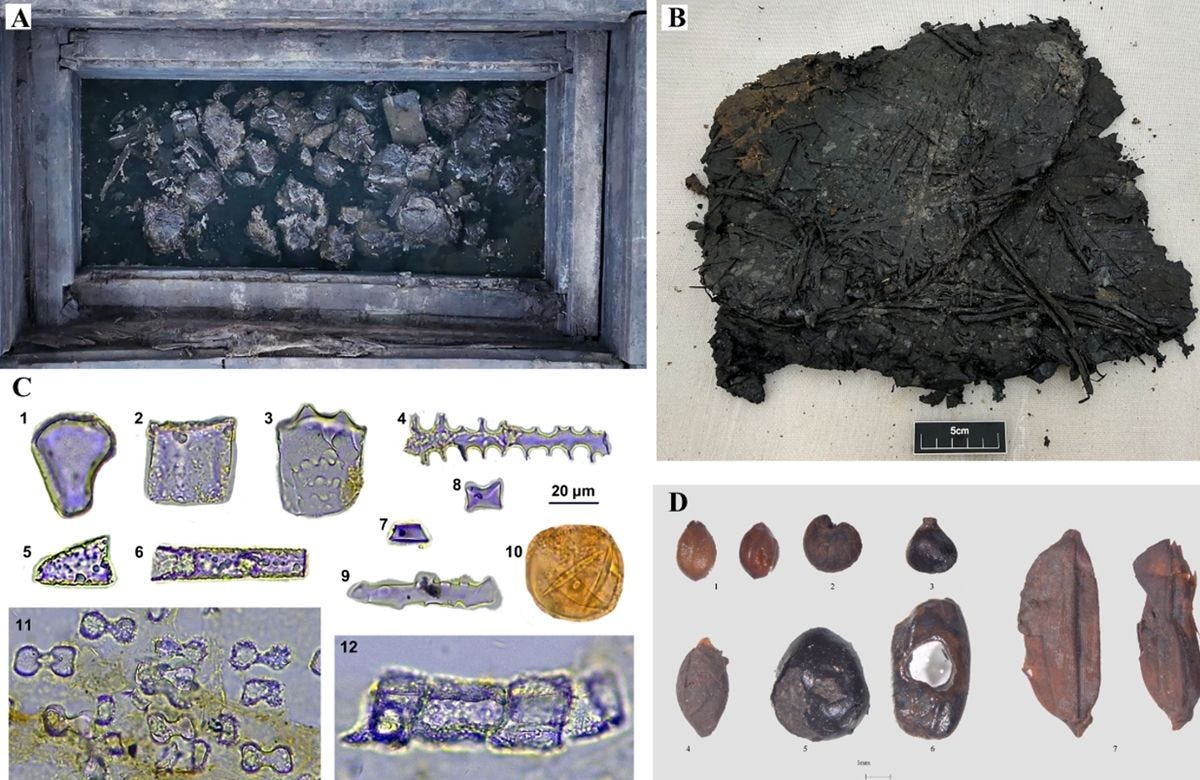
Inside: 456 seeds from ten of the bundles. Rice, Oryza sativa, made up 43.6 percent. Foxtail millet, Setaria italica, 28.5 percent. Broomcorn millet, Panicum miliaceum, 26.1 percent. Also present were a single seed of Zanthoxylum bungeanum and one of Malva sp., both aromatics used as spice, and six seeds of Scirpus juncoides, a weed of flooded rice fields that probably came along with the harvest.
So far this reads like lunch. A leaf packet of rice and millet, tied with grass rope, put in a tomb. Anyone who has eaten zongzi at the Dragon Boat Festival knows the object.


