
Somewhere in what is now the Dordogne, probably sometime around 65,000 years ago, a small group of Homo neanderthalensis survived. The continent around them was largely empty of their kind. The previous 30,000 years had not been kind. The climate had tightened, and the Neanderthals who had ranged from Iberia to the Caucasus and beyond had contracted into a rump population clinging to the warmer southwest of Europe. What happened to the others is not entirely clear. They didn’t disappear overnight. But when the data are assembled and analyzed, the genetic trace of that earlier diversity is almost entirely gone from the Late Neanderthal record.
That’s the central finding of a study published this month in PNAS1 by Charoula Fotiadou, Cosimo Posth, and a large international team. They sequenced ten new Neanderthal mitochondrial genomes from six archaeological sites in Belgium, France, Germany, and Serbia, and analyzed them together with 49 previously published sequences. The result is the most comprehensive picture yet of what happened to European Neanderthals in the millennia before they vanished.
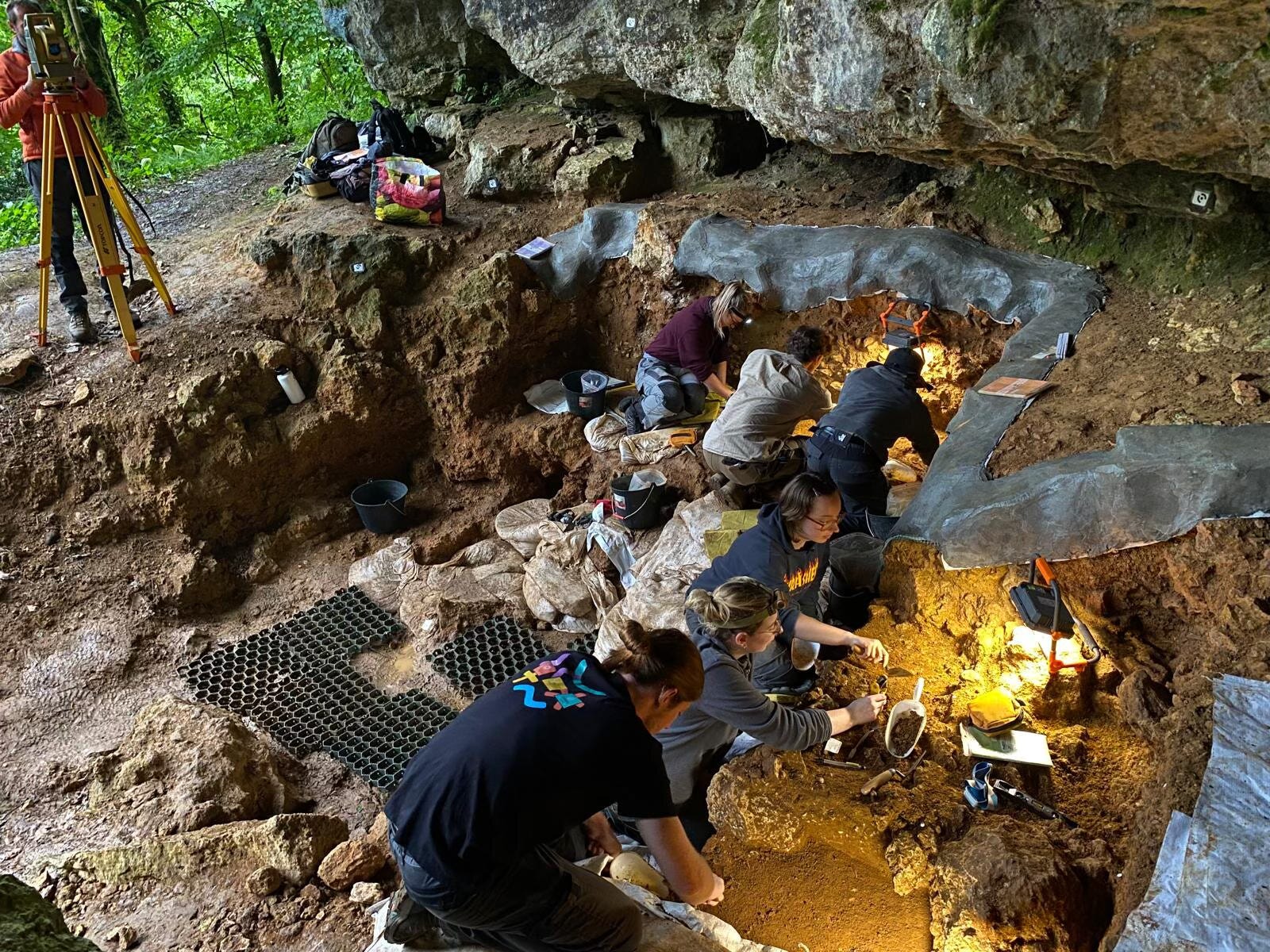
The conclusion is stark. Nearly every Late Neanderthal in Europe — individuals spanning from El Sidrón in Spain to Mezmaiskaya in the Caucasus — belongs to a single mitochondrial lineage. The team dates the diversification of that lineage to approximately 65,000 years ago, and the geographic and archaeological evidence converges on a single explanation: a population refugium in southwestern France.
The Genetic Contraction
To understand what’s unusual about this, it helps to know what preceded it. Neanderthals from before MIS 3 — the time period associated with the last Neanderthals — show considerably more mitochondrial diversity. The older European individuals in this dataset fall on more deeply branching lineages. Two specimens from Tourtoirac in France (indirectly dated to before 57,000 years ago) fall on different branches entirely, which is itself telling: within a single site, two Neanderthals carry distinct mitochondrial lineages. The same pattern holds for the pre-MIS 3 Neanderthal tooth from Pešturina Cave in Serbia, dated by OSL and ESR methods to around 111,000 years ago. These individuals were part of a more genetically varied world.
That world contracted. The researchers used the ROAD database — a large-scale archaeological repository developed by the ROCEEH project at the Heidelberg Academy — to track the geographic distribution of Neanderthal sites from 130,000 years ago onward, in 10,000-year slices. From 130,000 to about 80,000 years ago, Neanderthal sites are spread across western Eurasia, from the Iberian Peninsula to the Black Sea. Then the distribution tightens. By the 70,000–60,000 year window, site density is concentrated in southern France. The spatial statistics confirm this isn’t just a sampling artifact: hotspot analysis and rarefaction testing both support a genuine geographic contraction, not an illusion produced by uneven research coverage.
The timing fits what we know about MIS 4. This glacial stage, roughly 73,000 to 60,000 years ago, brought cold and dry conditions across much of Europe. The potential niche space available to Neanderthals, modeled using paleoclimate reconstructions, reached its smallest extent during this period. A refugium in southwestern France would have made environmental sense. The region offered milder conditions, river systems, and game. Something persisted there.
What followed that contraction was an expansion. After about 65,000 years ago, the diversity of mtDNA branches among Neanderthals effectively resets. The old lineages are gone, or nearly so. The population that survived in southwestern France radiated outward. By MIS 3, Neanderthals are again spread across the continent, but now they’re all carrying, maternally, the same ancestral signature. The rarefaction analysis shows the longitudinal spread of sites actually increases progressively after 80,000–70,000 years ago — statistically significant broadening that holds up even when controlling for sample size.
The molecular dating analysis, run in a Bayesian framework using radiocarbon-dated individuals as calibration points, pins the diversification of the main Late Neanderthal mtDNA branch at around 65,000 years ago (95% HPD interval: 76,000–56,000 years ago). Crucially, this event was preceded by a period of roughly 30,000 years during which no new mtDNA lineages appear to have diversified at all — a long plateau of genetic stasis spanning most of MIS 4. The surviving population was small and isolated enough that its mitochondrial lineages were simply not branching.
Goyet and What a Single Site Can Tell You
The Belgium site of Goyet — the Troisième caverne — is doing a lot of work in this dataset. It’s the most densely sampled Neanderthal site with multiple individuals, and the team added three more mtDNA sequences from it here. What’s remarkable about Goyet is not just the number of specimens but what they span: within a roughly 4,000-year window (45,000–41,000 years ago), the Neanderthal individuals at Goyet encompass almost the entire range of mtDNA diversity seen across Late Neanderthals in Europe. A single cave, a few thousand years, and you’ve essentially sampled the continent’s genetic breadth. The team notes this is statistically indistinguishable from the diversity observed across the whole main Late Neanderthal branch — and the Goyet assemblage is not even a population sample in any conventional sense. Zooarchaeological analysis of the site has previously shown that the Neanderthal remains there reflect selective cannibalism, not ordinary occupation debris.
Several of the newly dated Goyet specimens initially produced post-40,000-year radiocarbon dates — which would place them after the generally accepted timing of Neanderthal extinction. The team addresses this directly. Pairwise distance comparisons between some of these specimens and others from the same site show identical mtDNA sequences, suggesting they belong to the same chronological assemblage as Goyet individuals directly dated to 43,000–42,000 years ago. The anomalous radiocarbon results are attributed to collagen contamination from varnish applied to the specimens — a known problem with older museum collections. Molecular dating of these individuals produces ages consistent with the broader Goyet assemblage.
Two Late Neanderthals at the French sites of Les Cottés and Grotte Mandrin don’t fit neatly into the main Late Neanderthal lineage. Les Cottés Z4-1514, in particular, falls on a more divergent branch and shows a striking number of accumulated substitutions — more than any other Neanderthal in the dataset. Thorin from Grotte Mandrin, dated to around 50,000 years ago, behaves differently still, with an unusually short branch length that complicates molecular dating. These two individuals may represent lineages that persisted within or near the southwestern French refugium even as the rest of Europe’s Neanderthal diversity was replaced. They’re the exceptions that confirm the pattern — surviving remnants of pre-bottleneck diversity sheltering in the same geographic region that gave rise to the dominant Late Neanderthal lineage.
The Final Decline
The demographic analysis doesn’t stop at the bottleneck. Running a Coalescent Bayesian Skyline analysis on the western Eurasian Neanderthal mtDNA sequences, the team identifies a sharp decline in effective population size beginning around 44,500 years ago and reaching its lowest point around 42,000 years ago. This is shortly before most estimates for final Neanderthal disappearance in Europe, which radiocarbon work by Higham and colleagues had placed around 40,000 years ago.
What drove that final decline is not answered by this study. The population had already been severely bottlenecked once. Low genetic diversity in a small, fragmented population has well-documented consequences — reduced adaptive potential, increased vulnerability to inbreeding, susceptibility to stochastic local extinctions. The authors note that a recent morphological study of Neanderthal semicircular canals independently identified a similar bottleneck event. These lines of evidence are converging.
The arrival of Homo sapiens in Europe was happening during this same period, though the relationship between that arrival and Neanderthal demographic collapse remains genuinely contested. This study doesn’t adjudicate between climate and competitive displacement as proxies for the final decline — the mtDNA data can show the timing of the crash, not its cause.
What it does show is that the genetic story of Late Neanderthals is not one of steady decline from a diverse, continent-wide population. It’s a story of prior collapse, narrow survival, expansion from the remnant, and a second collapse. The Neanderthals who spread across Europe in the last 25,000 years of their existence were not the same populations that had previously inhabited those landscapes. They were the descendants of survivors, carrying a single maternal lineage into territories where older Neanderthal diversity had already been lost.
Whether the material culture of this period reflects that demographic history is another question. The authors point out that despite the genetic homogeneity of Late Neanderthals, their archaeological assemblages are far from uniform — the Mousterian and its variants show regional variation that doesn’t map straightforwardly onto the genetic signal. The genes converge; the toolkits don’t, at least not obviously. That gap between genetic and cultural patterning is one of the more interesting problems the study leaves open.
Further Reading
Hajdinjak, M., et al. Reconstructing the genetic history of late Neanderthals. Nature 555, 652–656 (2018).
Posth, C., et al. Deeply divergent archaic mitochondrial genome provides lower time boundary for African gene flow into Neanderthals. Nature Communications 8, 16046 (2017).
Peyrégne, S., et al. Nuclear DNA from two early Neandertals reveals 80,000 years of genetic continuity in Europe. Science Advances 5, eaaw5873 (2019).
Slimak, L., et al. Long genetic and social isolation in Neanderthals before their extinction. Cell Genomics 4, 100593 (2024).
Higham, T., et al. The timing and spatiotemporal patterning of Neanderthal disappearance. Nature 512, 306–309 (2014).
Urciuoli, A., et al. Semicircular canals shed light on bottleneck events in the evolution of the Neanderthal clade. Nature Communications 16, 972 (2025).
Kandel, A.W., et al. The ROCEEH Out of Africa Database (ROAD): A large-scale research database serves as an indispensable tool for human evolutionary studies. PLoS ONE 18, e0289513 (2023).
Banks, W.E., et al. An ecological niche shift for Neanderthal populations in Western Europe 70,000 years ago. Scientific Reports 11, 5346 (2021).
Yaworsky, P.M., Nielsen, E.S., Nielsen, T.K. The Neanderthal niche space of Western Eurasia 145 ka to 30 ka ago. Scientific Reports 14, 7788 (2024).
Rougier, H., et al. Neandertal cannibalism and Neandertal bones used as tools in Northern Europe. Scientific Reports 6, 29005 (2016).
Fotiadou, C.M., Pedersen, J.B., Rougier, H., et al. Archaeogenetic insights into the demographic history of Late Neanderthals. Proceedings of the National Academy of Sciences 123(13), e2520565123 (2026). https://doi.org/10.1073/pnas.2520565123


