
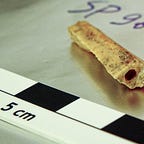
The bone fragment pulled from Denisova Cave is 2.5 centimeters long. It was dug out of Layer 12 of the East Chamber, a vaulted space in the Altai Mountains of southern Siberia where the light changes color in the afternoon and winter can kill you if you’re unprepared. The fragment was identified as hominin through ancient protein analysis, not morphology — it looks like nothing in particular. Then researchers drilled into it and extracted DNA from the powder, and what came out was one of the better-preserved Neandertal genomes ever sequenced: 37-fold average coverage from a single library, better than most ancient genomes require five to twenty libraries to achieve.
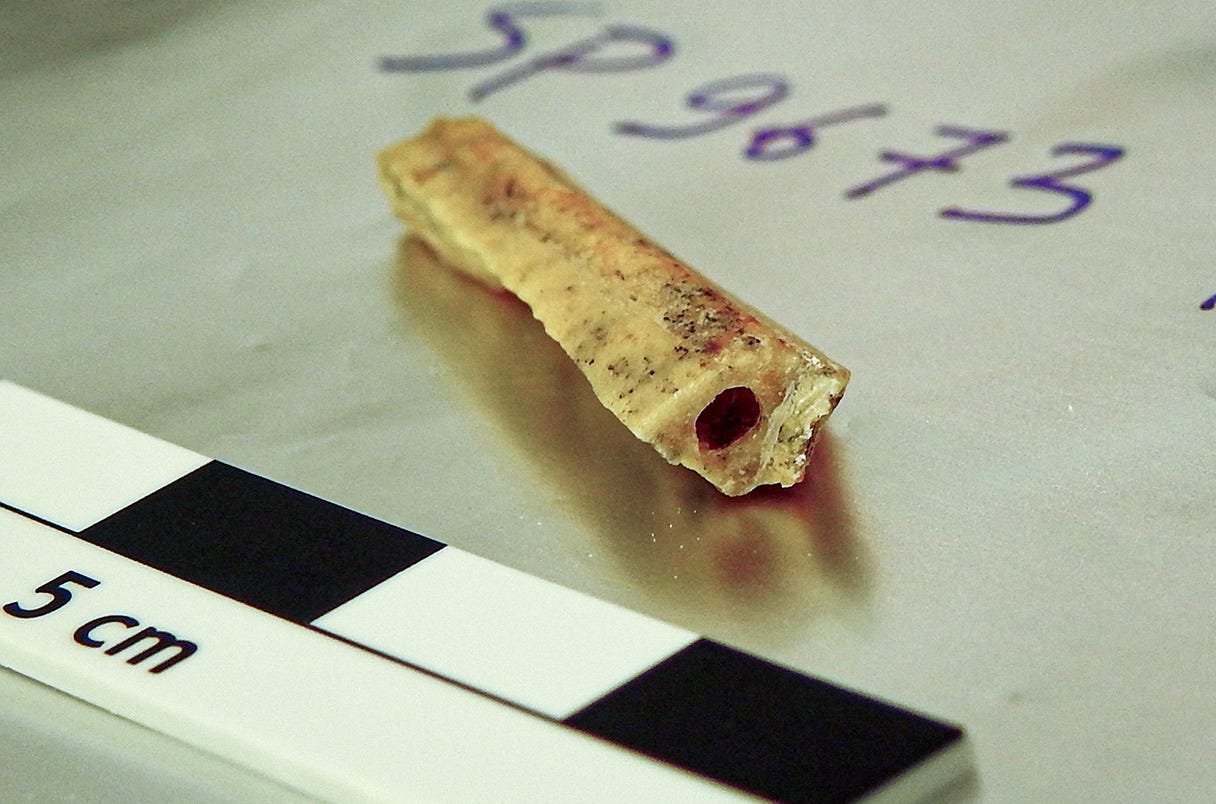
The individual was male. He was probably about 110,000 years old. He had never been named or catalogued as a skeleton. He was, effectively, nobody — until he became one of the most informative people from the Pleistocene.
Two studies published this week in PNAS,1 2 both drawing on new Neandertal genomic data, arrive at a picture of Homo neanderthalensis that is striking for how fragile it makes them look. Not just at the end, in the final few thousand years before their disappearance, but throughout their entire existence across Eurasia. They were a species running on fumes.
The Fracture Lines
The Denisova Cave individual — referred to in the Massilani et al. paper as Neandertal D17 — belonged to a population of Eastern Neanderthals more closely related to another individual from the same cave, roughly 120,000 years old and female, than to any Neandertal from Western Europe. This isn’t surprising on its face: they came from the same place. What is surprising is the degree of genetic separation between these eastern Altai Neanderthals and the western populations in Europe.
The standard measure for comparing population differentiation is FST, which runs from 0 (identical) to 1 (completely separated). Among living humans, the most genetically distant populations on earth — Central African forest-dwelling groups like the Mbuti compared to Papuan Highlanders — reach an FST of around 0.27. These are populations that diverged somewhere between 130,000 and 220,000 years ago and have been largely separate ever since.
The gap between Eastern Neanderthals (D5 and D17 from Denisova Cave) and Western Neanderthals (represented by individuals from Vindija Cave in Croatia and a newly sequenced genome from Belgium) comes out at FST = 0.30. That is larger than the most differentiated living human populations. The Eastern and Western Neandertal lineages diverged only about 115,000 years ago, compared to 260,000 to 440,000 years of separate drift between Mbuti and Papuans. Neanderthals were differentiating faster. The Massilani team attributes this to smaller effective population sizes, which amplify genetic drift: when groups are small and isolated, allele frequencies shift quickly just by chance, without any particular selective pressure driving them.
How small were these groups? The genome of D17 shows that about 24 percent of his DNA sits in long homozygous runs — stretches where both copies of a chromosome are identical, a signature of recent inbreeding. In D5, the older female from the same cave, the figure is 20 percent. The Denisovan individual from the same site sits at 4 percent. Early modern humans come in between 1 and 6 percent. Population modeling using the length and distribution of these homozygous tracts suggests that the Altai Neanderthals — both the older Eastern ones and a later, Western-derived individual named Chag8 from a different cave in the same region — were living in groups of fewer than 50 individuals under realistic migration scenarios. The later Western Neanderthals in Europe appear to have lived in somewhat larger groups, but not dramatically so.
Princeton geneticist Joshua Akey, who was not involved in either study, put it plainly: the global Neandertal population was probably only a few thousand breeding individuals, spread across most of Eurasia.
There is something almost incomprehensible about that. Modern humans, for all the times we almost went extinct, have never been that reduced on a global scale while simultaneously occupying that much space.
The Bottleneck You Can See Coming
The second study, led by Charoula Fotiadou and Cosimo Posth at the University of Tübingen, approaches Neandertal demography from the other direction: not nuclear genomes from individuals, but mitochondrial DNA from dozens of specimens spanning the last 130,000 years of Neandertal history in Europe. Mitochondrial DNA is maternally inherited and present in large quantities in ancient bone, which makes it tractable even from fragmentary material. The team generated ten new mtDNA sequences from six sites in Belgium, France, Germany, and Serbia, and analyzed them against 49 previously published sequences.
The pattern they found is stark. Before about 75,000 years ago, European Neanderthals showed multiple distinct mtDNA lineages. Individuals from different sites across the continent sat on different branches of the phylogenetic tree. There was genetic diversity — not a lot by modern human standards, but genuine regional variation.
Then it collapses.
The vast majority of Late Neanderthals, those living after about 57,000 years ago, cluster within a single mtDNA lineage. From Iberia to the Caucasus, across the whole surviving range of European Neanderthals, almost everyone is descended in the maternal line from the same ancestral population. The analysis places the origin of that lineage at around 65,000 years ago, with a 95 percent confidence interval running from 56,000 to 76,000 years ago. And it pinpoints the likely geographic source: southwestern France.
What happened in between is not hard to guess. Marine Isotope Stage 4 — the glacial period peaking roughly 73,000 to 60,000 years ago — was cold and dry across Europe. The Fotiadou team’s analysis of the archaeological record, drawing on the ROCEEH Out of Africa Database (ROAD), shows Neandertal sites becoming dramatically concentrated in southwestern Europe during this period. The hotspot visible in the data through the 70,000 to 60,000 year window sits in southern France. Structured statistical tests on the spatial data show this cannot be explained by research bias or uneven sampling. Something pulled Neanderthals into that corner of the continent.
The genetic and archaeological evidence converge on the same scenario: a population that had been distributed across most of Eurasia contracted into a refugium. Most of the earlier diversity was lost. Whatever lineages existed outside that southwestern European core either died out or were so reduced as to leave no detectable genetic trace in later populations. The only exceptions are two individuals in France — one from Les Cottés, one from Grotte Mandrin — whose mtDNA sits outside the main Late Neandertal lineage, suggesting the refugium itself preserved at least some of the older variation.
When the ice retreated, sometime after 65,000 years ago, the survivors spread out again. Neanderthals reappeared at sites across Europe and into the Caucasus. But they were now, in the maternal genetic record, essentially one people. University of Tübingen paleogeneticist Cosimo Posth, a co-author on the Fotiadou study, described it directly: all the genetic diversity visible in the mitochondrial record before 60,000 years ago disappears, and a single lineage survives.
This is not extinction followed by replacement from somewhere outside. There is no external source population arriving from Asia or Africa. The Neanderthals who recolonized Europe after the glacial maximum were the descendants of the ones who had sheltered in southwestern France. What the bottleneck destroyed, you cannot get back.
42,000 Years Ago
The Bayesian skyline analysis in the Fotiadou study tracks effective population size through time, and the trajectory at the end is what you might expect given everything else in the data. There is no gradual thinning out. The line holds roughly steady until around 44,500 years ago, then drops sharply. It reaches its minimum around 42,000 years ago.
That timing overlaps with the arrival of anatomically modern humans in Europe, which most evidence places between 45,000 and 43,000 years ago, and with the sharp climatic instability of Greenland Interstadial transitions around the same period. Qiaomei Fu, a geneticist at the Chinese Academy of Sciences not involved in either paper, noted that for a population already as constrained as the Neanderthals had become, environmental volatility would have been especially dangerous. When you have no buffer — no large connected populations to draw migrants from, no reservoir of genetic diversity to draw on — each stochastic shock matters more.
Within roughly 3,000 years of that decline beginning, the Neandertal genetic signal disappears from the record entirely. Except, of course, for what survived through admixture with modern humans — the 1 to 4 percent of Neandertal ancestry still present in the genomes of everyone alive today outside sub-Saharan Africa.
Something else emerges from the Denisova Cave genome. The two oldest individuals from that site — D5 (around 120,000 years old) and D17 (around 110,000 years old) — both carry segments of DNA that trace to Denisovan ancestry. The locations of Denisovan-like segments in the two genomes are significantly correlated, suggesting they shared at least some of the same introgression events. But the later Neandertal from the region — Chag8, from nearby Chagyrskaya Cave, dating to around 80,000 years ago — shows no comparable Denisovan signal. Neither does the Western European Neandertal from Vindija. The Massilani team’s interpretation is tentative but suggestive: the Western-derived population that replaced the Eastern Neanderthals in the Altai sometime between 110,000 and 80,000 years ago may have been recent arrivals with no prior contact with Denisovans, or their ancestors may have arrived after whatever direct interactions the earlier populations had experienced.
It is a strange thing to contemplate: two groups of Neanderthals, separated by perhaps 10,000 years, occupying the same cave system at different times, genetically distinct enough from each other to be classified into separate regional populations, each leaving a different archaeological footprint, each with different admixture histories. And none of them aware that in some broader sense they were all running out of time.
Max Planck geneticist Hugo Zeberg, a co-author on the Massilani paper, framed the comparative value of these datasets in terms of natural experiments. Modern humans, Neanderthals, Denisovans: three lineages navigating the same world during overlapping time periods. The question of why one of them is still here is not answered by these papers, but it gets sharper. Neandertal populations, the data suggest, were almost never large enough to absorb disruption the way modern human populations apparently could. The differentiation exceeded anything seen in living humans today — and it happened faster, over shorter timescales, because the groups were smaller and more isolated. Drift overwhelmed everything else.
The bone fragment from Denisova Cave is 2.5 centimeters long. From it, researchers reconstructed a genome that shows a man living in a population of fewer than 50 people, already genetically separated from the people his kind would later become, already carrying DNA from another species entirely. He was part of a group at the far eastern edge of its range, in a mountain cave in Siberia, 110,000 years ago.
Whether that feels like isolation or just ordinary life is a question the data cannot answer.
Further Reading
Hajdinjak, M., et al. (2018). Reconstructing the genetic history of late Neanderthals. Nature 555, 652–656.
Mafessoni, F., et al. (2020). A high-coverage Neandertal genome from Chagyrskaya Cave. PNAS 117, 15132–15136.
Prüfer, K., et al. (2014). The complete genome sequence of a Neanderthal from the Altai Mountains. Nature 505, 43–49.
Prüfer, K., et al. (2017). A high-coverage Neandertal genome from Vindija Cave in Croatia. Science 358, 655–658.
Slimak, L., et al. (2024). Long genetic and social isolation in Neanderthals before their extinction. Cell Genomics 4, 100593.
Skov, L., et al. (2022). Genetic insights into the social organization of Neanderthals. Nature 610, 519–525.
Higham, T., et al. (2014). The timing and spatiotemporal patterning of Neanderthal disappearance. Nature 512, 306–309.
Urciuoli, A., et al. (2025). Semicircular canals shed light on bottleneck events in the evolution of the Neanderthal clade. Nature Communications 16, 972.
Fotiadou, C.M., Pedersen, J.B., Rougier, H., Roksandic, M., et al. (2026). Archaeogenetic insights into the demographic history of Late Neanderthals. PNAS 123(13), e2520565123. https://doi.org/10.1073/pnas.2520565123
Massilani, D., Peyrégne, S., Iasi, L.N.M., de Filippo, C., et al. (2026). A high-coverage Neandertal genome from the Altai Mountains reveals population structure among Neandertals. PNAS 123(13), e2534576123. https://doi.org/10.1073/pnas.2534576123


