
Palau has been irritating researchers for decades. The archipelago sits in the western Pacific, and it was settled around the same time as the great Lapita expansion — that eastward push of Southeast Asian seafarers who spread across the tropical islands roughly 3,200 years ago, leaving their distinctively patterned pottery everywhere they went. Except in Palau. Not a single shard of Lapita ceramics has ever turned up there. And while Palauans speak a form of Austronesian, it belongs to an entirely different branch than the languages spoken across the rest of Remote Oceania — a branch that linguists describe as deriving straight from Southeast Asia rather than from any later Oceanic offshoot.
So who were the first Palauans? The assumption has been that they were part of the broader Lapita world, or adjacent to it, with their peculiarities chalked up to geographic isolation and cultural drift. A new study published in Cell1 in March 2026 suggests the reality is stranger and, in retrospect, more interesting than that.
The research team, led by evolutionary biologist David Reich at Harvard and Ron Pinhasi at the University of Vienna, extracted genome-wide ancient DNA from the skeletal remains of 21 unrelated individuals recovered from archaeological sites across the Palauan archipelago. These people had lived there between roughly 2,900 and 500 years ago, meaning the dataset spans most of Palau’s known human occupation. Using petrous bones — the dense portion of the skull that best preserves DNA in warm, humid climates — the team recovered material of sufficient quality for genome-wide analysis, which had never been done for ancient Palauans before.
What they found upended a basic assumption about Pacific population history.
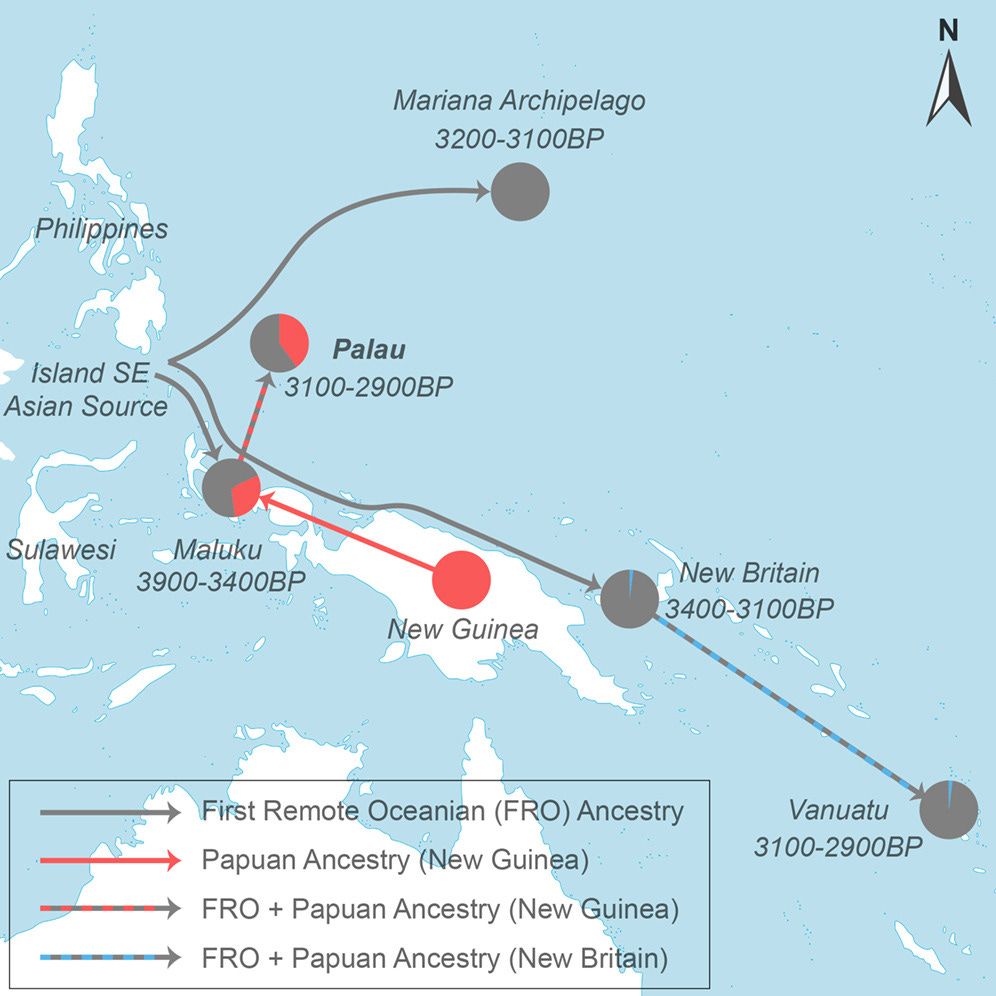
The earliest Palauans were not a homogeneous Southeast Asian population who later absorbed Papuan ancestry, as has been documented in other parts of Remote Oceania. They arrived already mixed. Ancient individuals from the earliest strata of occupation showed approximately 60 percent East Asian ancestry and 40 percent Papuan ancestry — a ratio that stayed strikingly consistent across the entire 2,800-year span of the dataset.
In Vanuatu and Fiji, the sequence runs differently. Early settlers there were essentially pure Southeast Asian. Papuan ancestry filtered in centuries later, carried by different groups moving through island Melanesia. Palau doesn’t follow that trajectory at all. The mixing had already happened, before the boats left.


