

Somewhere on the basalt plateau of the central Golan Heights, there is a structure that has baffled archaeologists since a military officer named Yizhaki Gal stumbled across it in 1968 while examining aerial photographs taken for an entirely different purpose. What Gal saw was a central cairn roughly five meters tall, ringed by four concentric walls of stacked basalt stone — some standing more than two and a half meters high and three meters wide — with radial walls connecting the rings at irregular intervals and two entrances breaking the outer circuit, one to the northeast, one to the southeast. The whole thing exceeds 150 meters across.
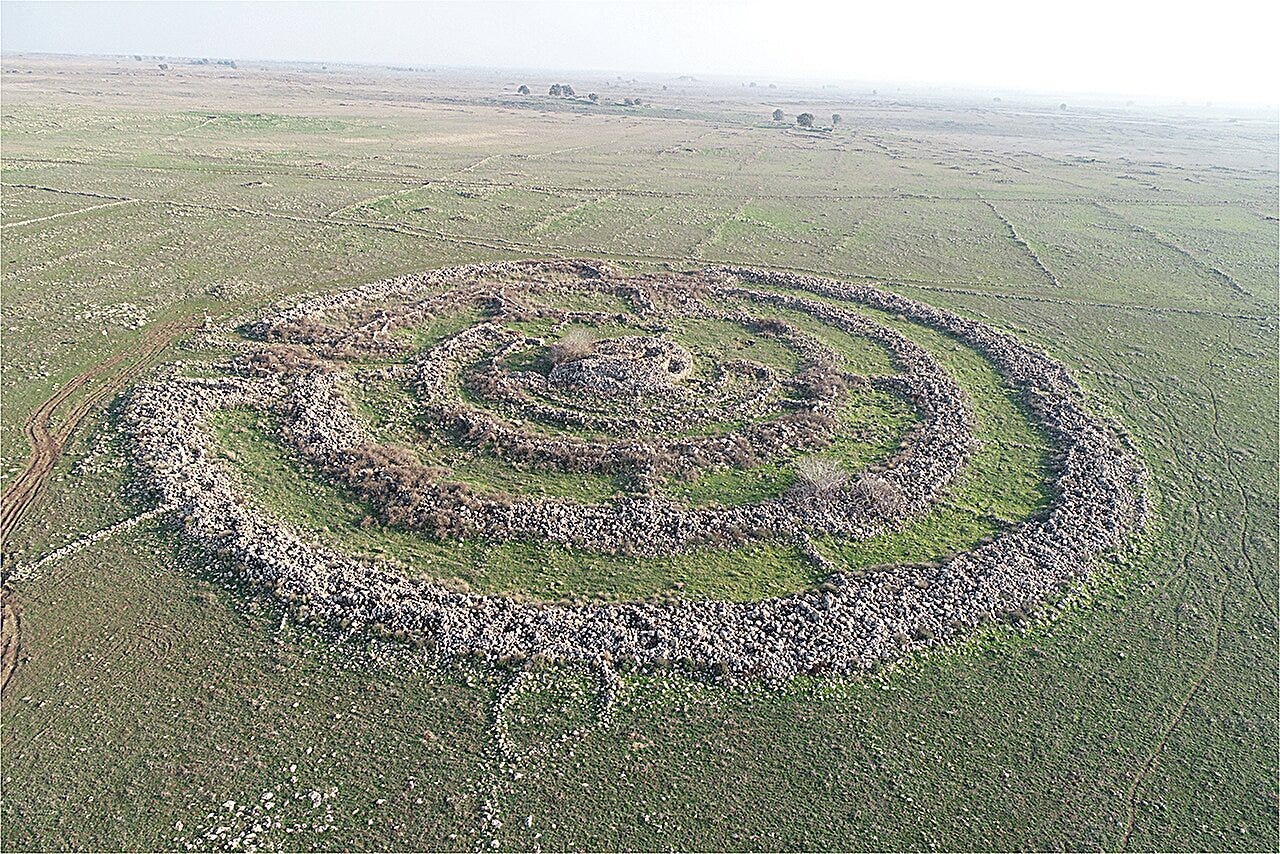
Rujm el-Hiri, as the site is known in Arabic (Hebrew speakers call it Rogem Hiri), has been excavated, surveyed, debated, and nicknamed “the Israeli Stonehenge” by people who apparently found the Rephaim, the biblical race of giants traditionally associated with the region, a serviceable explanation for how something this large ended up in the middle of nowhere. Its date is still genuinely uncertain: proposed construction periods range from the Chalcolithic through the Early Bronze Age to the Late Bronze Age, depending on which finds from which part of the site a given scholar weights most heavily. Excavations have yielded little that resolves the question definitively.
The function has fared no better. It has been called a burial monument, a ceremonial gathering ground for dispersed pastoral tribes, a defensive installation, and — most influentially in the popular imagination — an astronomical observatory, with the northeast entrance thought to align with the summer solstice sunrise. A 1998 study by Aveni and Mizrachi set out the geometry in detail and became widely cited. The astronomical interpretation proved sticky, partly because it is elegant, partly because the site offers no better explanation.
What all these interpretations share, beneath their differences, is a common premise: Rujm el-Hiri is unique. No comparable structure had been found within its vicinity. That uniqueness was doing a lot of interpretive work. If something is one of a kind, it is easier to imagine it as a special-purpose monument rather than one instance of a recurring practice. The absence of parallels made it easier to project singular meaning onto it.
A new study published in March 2026 in PLOS One,1 led by Michal Birkenfeld of Ben-Gurion University of the Negev and co-authored with Olga Khabarova, Lev V. Eppelbaum, and Uri Berger, has demolished that premise. Using high-resolution satellite imagery collected over a twenty-year span, combined with geophysical modelling and spatial analysis, the team identified 28 previously undocumented large circular stone structures within a 25-kilometer radius of Rujm el-Hiri. Only two examples had been recorded before in any survey. The others had simply never been seen.


