

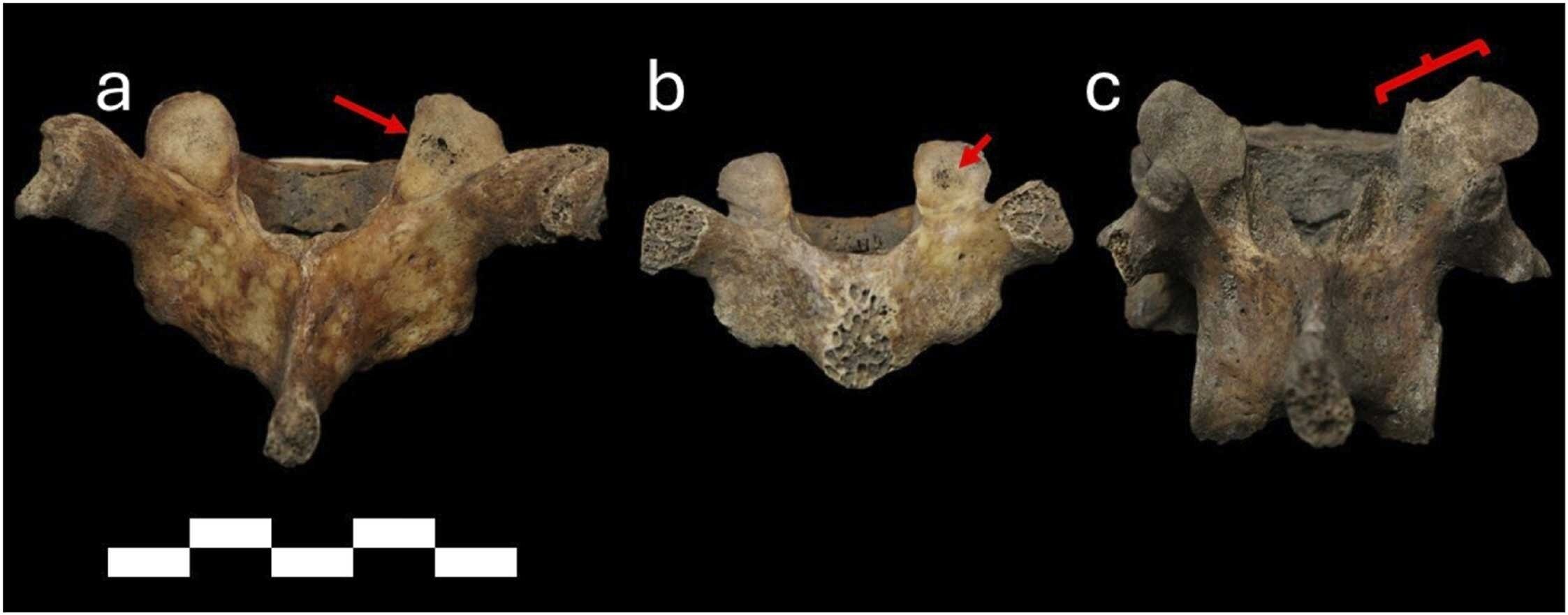
The skeleton catalogued as MB11 V0944 belonged to someone who died at about seventeen, give or take a year, and was buried in the Keyser church cemetery in Middenbeemster, a dairy village north of Amsterdam. Three of the thoracic vertebrae, T8, T9 and T11, carry Schmorl’s nodes: shallow craters on the flat surfaces of the vertebral body where the cushioning disc has pushed up through the bony endplate. T12 shows osteophytic growth on the facet joint. In a living patient, that combination would raise questions about decades of loading. This individual had not finished growing.
Another, ARJB V0522, from the Saint Eusebius church cemetery in Arnhem, was around ten years old. One facet joint on T5 already shows the pitting and contour change that pathologists associate with cartilage failure.
These two are among 143 individuals, aged from four to twenty-five at death, analysed by Alex Tutwiler and Rachel Schats of Leiden University in a paper published in the International Journal of Paleopathology.1 The question they set out to answer is one that Dutch historical records, for all their bureaucratic thoroughness, cannot touch. The archives tell us how many children worked, at what age they started, how many hours they put in and what they were paid. They say almost nothing about what the work did to the bodies doing it.
Three cemetery assemblages, three different lives. Keyserkerk in Middenbeemster is rural and low-to-middling in status, its economy built on dairy cattle and cheese; the burials there date from 1829 to 1866, and 51 individuals from the site met the study’s criteria. Eusebiuskerk in Arnhem is urban and poor, drawn from the outer northern portion of the churchyard where the lower social strata were interred; it dates from 1626 to 1829 and contributed 49 individuals. Nieuwe Kerk in Delft is the control of sorts: 43 individuals from graves in the church choir, dating from 1624 to 1814, belonging to families wealthy enough to be buried inside the church and almost certainly exempt from work. Arnhem had tobacco processing, textile manufacture, brick-making and paper mills. Delft had trade, and children who studied.
What Tutwiler and Schats looked for were three kinds of change, all of them things that clinicians normally see in middle-aged and older patients. Facet joint osteoarthritis is degeneration of the small paired synovial joints at the back of each vertebra, the ones that let the spine bend and twist while bearing up to a third of the load passing through a spinal segment. Schmorl’s nodes are the disc-through-endplate herniations described above, linked clinically to compressive and shearing force. Vertebral body margin modifications are new bone forming as a lipped rim around the edge of the vertebral body, most often in response to disc degeneration. None of these is caused by labor alone. All three have genetic, developmental and traumatic contributions. What makes them interpretable here is age. In a fifty-year-old the signal is drowned out by ordinary senescence. In a nine-year-old there is much less noise.
Middenbeemster came out worst on every measure the study applied. Overall lesion prevalence there reached 62.6 percent in the upper thoracic vertebrae and 68.4% in the lower thoracic, higher than any spinal region at either of the other sites. The gap held across every age category, from the youngest children through the early young adults, and it held for Schmorl’s nodes and for margin modifications assessed separately.
The upper thoracic figure is the strange one. That stretch of spine, T1 through T6, is the least mobile part of the column, splinted by the ribcage and comparatively protected from the flexion and rotation that wreck the lumbar region. Children in a dairy village were wearing it out anyway. Tutwiler and Schats attribute this to the muscles that anchor there rather than to the vertebrae themselves. The rhomboids and trapezius originate on the spinous processes of the upper thoracic spine and stabilize the shoulder girdle, and they are exactly the muscles a small body recruits when it lifts something heavier than it should. Beemster children were milking cows and taking part in cheese-making by the age of nine, according to an agricultural survey from 1800. Cheese-making meant hauling milk basins, churning, and lifting and pressing moulds, done in a hunched posture, repeatedly, by people who did not yet have the body mass to do it without strain.


