
In 2021, a metal detectorist named Peter Heads was working a field at Melsonby in North Yorkshire when he started pulling up pieces of corroded metal that didn’t fit any obvious pattern. Bent iron rings. Ornate copper-alloy fittings. Fragments of harness hardware. He contacted Tom Moore at Durham University. By the time excavation was complete in 2022, the site had yielded1 two separate deposits comprising nearly 950 individual objects, making it one of the largest Iron Age metalwork finds ever recovered in Britain.
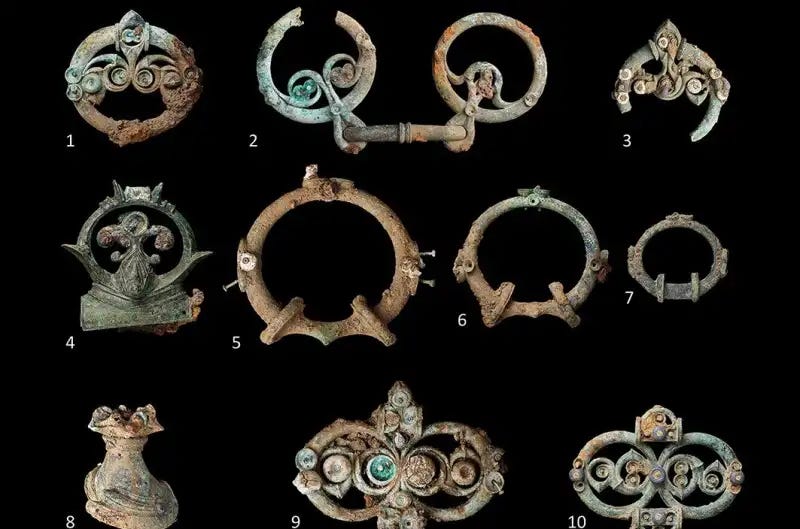
The word hoard tends to flatten what was actually there. These weren’t coins or ingots. The assemblage was dominated by the disassembled remains of horse-drawn vehicles: iron tyres, linchpins, yoke fittings, rein rings, kingpins, nave bands, harness straps adorned with Mediterranean coral and glass enamel. There were cauldrons, spears, an iron mirror, fragments of melted silver. Three quarters of the material derived from horse-drawn vehicles and their harness. Whatever was buried here, someone had gone to considerable effort to gather it and dismantle it before putting it in the ground.
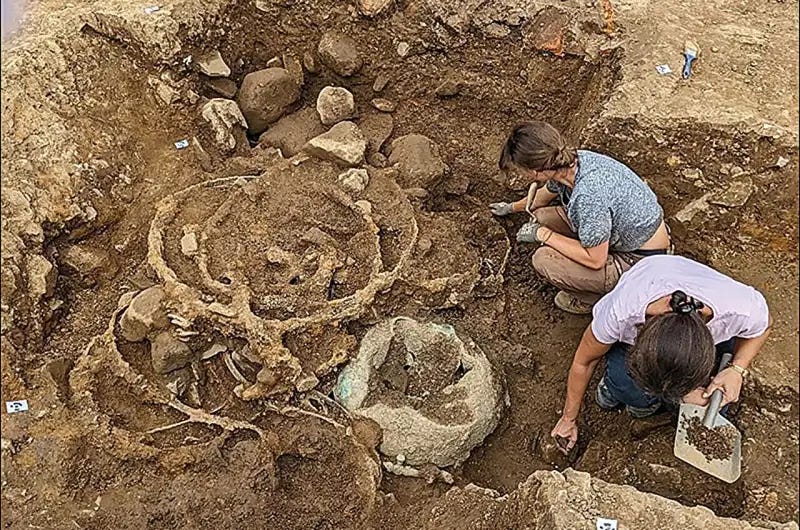
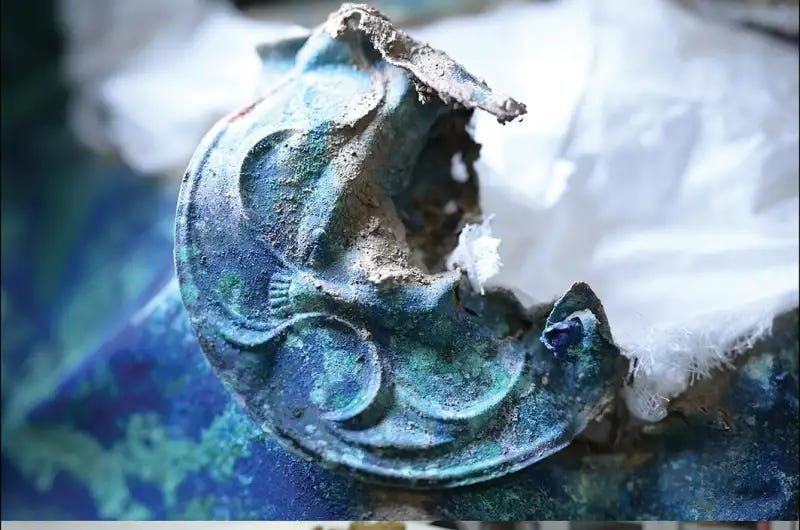
The first deposit, designated Hoard 1, was placed at the bottom of a ditch. Its core was 28 iron tyres, all of them bent or deformed before deposition, some entirely out of shape, then stacked carefully. Hundreds of other metal items were entangled within and around them. An inverted cauldron sat over part of the pile; a lidded vessel had been placed upside down at the base. While the pit was open, large rocks were thrown in. One of them crushed the cauldron. The base of that cauldron bears a repoussé fish motif in Celtic curvilinear style, possibly trout or salmon set in swirling water. Depictions of fish are rare on Iron Age metalwork across Europe, and worth noting here because the British Iron Age has a documented and debated pattern of apparent fish avoidance, visible in the zooarchaeological record.
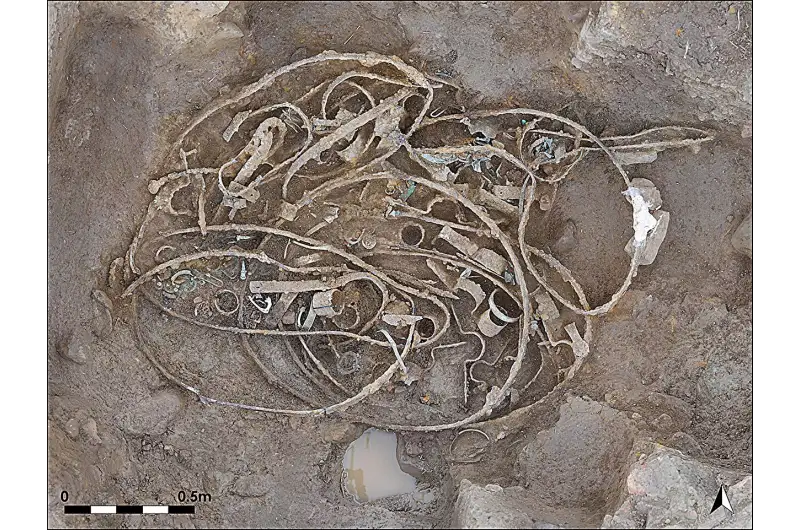
The second deposit, Hoard 2, was found about 25 metres away. It had fused into a solid mass through iron corrosion, making field excavation impossible. The team lifted it as a block and sent it to the University of Southampton for CT scanning. Inside: more horse harness, iron spears, copper-alloy tubes, and what appears to be an iron pilum shaft threaded through hollow copper fittings. Traces of mineralised textile on the block’s edges and textile impressions in the surrounding fill indicate the bundle had been wrapped before burial. The researchers have decided not to disassemble it. Doing so would destroy one of the few preserved records of how such a deposit was actually constructed.
The Case for Wagons
The most significant finding from Melsonby, in terms of what it changes about the Iron Age British record, is the evidence for four-wheeled wagons. Until now, the British evidence for Iron Age wheeled vehicles consisted almost entirely of two-wheeled chariots, mostly from burials on the Yorkshire Wolds dating to the Middle Iron Age, roughly 400 to 150 BC. A single Late Iron Age chariot burial has been identified in Pembrokeshire. That is essentially the extent of the direct evidence.
The Melsonby assemblage suggests something different was in use in northern Britain by the first century AD. The U-shaped iron brackets found in Hoard 1 are not known from British two-wheeled chariot contexts anywhere. They have nails protruding from their arms, indicating attachment to thick wooden elements around cylindrical components, and they fit cylindrical iron bands that closely resemble hub collars from four-wheeled wagons on the continent, particularly those dated from around 100 BC to the first century AD. The iron tyres range from 0.77 to 1.08 metres in diameter, larger than those typical of lightweight chariots, and the harness fittings are atypically oversized throughout. Most telling are the kingpins: components specific to wagon steering mechanisms, with no function on a two-wheeled vehicle.
The closest material parallel is a pair of four-wheeled wagons recovered from a peat bog at Dejbjerg in Denmark, dated to around 100 BC. Those wagons were buried in pieces but retained their copper-alloy fittings, several of which resemble items from Melsonby: tubes and ferrules, finials, openwork ornamentation. A small repoussé face from Hoard 2 echoes faces decorating the Dejbjerg wagons. Four-wheeled vehicles are well documented across Late Iron Age continental Europe. Their presence in Britain had been anticipated on circumstantial grounds, but never confirmed with physical evidence. The Melsonby deposits represent, in the team’s assessment, the first tangible instance.
At minimum, the assemblage accounts for seven vehicles. Possibly more, possibly a mixture of four-wheeled wagons and lighter two-wheeled carts. The harness fittings across Hoards 1 and 2, and a third hoard found at the same site in 1843, show closely related stylistic groupings suggesting multiple matched sets, made in related workshops, treated as sets in deposition. The 1843 find appears to have included a separate cache of large iron wheel rims, described at the time as “iron hoops, conjectured to be tyres of chariot wheels.”
What Was Being Destroyed, and Why
The manner of deposition is as striking as the objects themselves. The vehicles had been dismantled. Many items had been deliberately bent, broken, or exposed to intense heat before burial. Partially melted copper-alloy objects, glass droplets, and melted silver were distributed throughout Hoard 1. The iron tyres had probably been heated to enable bending, a process that left haematite traces on their surfaces. But none of this burning happened in the pit: the surrounding sediment showed no discolouration, no charcoal concentration. The material had been processed elsewhere, then brought here.
One possibility is that these objects had been placed on a funeral pyre and then transferred to the ditch. This has been proposed for the 1843 hoard and for similar burning-affected metalwork deposits elsewhere. It fits what the rest of the assemblage contains. The large cauldron, with an estimated capacity of around 35 litres, the second vessel whose form echoes Etruscan wine-mixing bowls and which bears cast human face masks and applied coral studs, the iron mirror, the weapons: these are objects associated with feasting, display, and status. As a category they resemble elite funerary deposits from southern Britain in the same period, including assemblages from Lexden in Colchester and Folly Lane in St Albans.
There are no human remains at Melsonby. The small quantities of bone recovered appear to be animal, including probable cremated animal bone in Hoard 2’s trench. The researchers are careful about what this absence means. They point out that hoards, votive deposits, and funerary assemblages represent a continuum of practice rather than clearly bounded categories. The absence of a body does not exclude a funerary event. Cremation was becoming more common in Late Iron Age southern Britain; human remains may have been deposited in ways that are archaeologically invisible, or the event may have involved exposure to a funerary pyre without any conventional burial at all.
The site sits about 800 metres from the Late Iron Age oppidum at Stanwick, one of the major power centres of northern Britain and the probable seat of the Brigantes, a tribal confederacy described by classical writers. Stanwick was occupied through the first century BC and first century AD, precisely the period that preliminary radiocarbon dates from the Melsonby deposits indicate. Hoard 1 most probably dates to between 35 cal BC and cal AD 40, with Hoard 2 falling in a similar range. The assemblage includes Roman-influenced objects consistent with Stanwick’s documented engagement with Roman material culture beginning around the turn of the millennium.
Tacitus identified Queen Cartimandua as a Brigantian client ruler allied with Rome, active around AD 51 to 69. The team notes that the Melsonby dates, if the deposits are connected to a funerary event, suggest the person being commemorated was more likely Cartimandua’s parent or grandparent than Cartimandua herself. That doesn’t diminish the connection to Stanwick’s political world. The Brigantian reach suggested by the objects is wide: decorative motifs connecting to metalwork from southern Scotland to southern England, Mediterranean coral, Roman-influenced forms. And other aspects of the deposits are worth sitting with. The communal feasting equipment, the relative absence of personal ornaments like brooches, the sheer scale of destruction involved: whatever event this was, it seems to have been as much about collective display as about any individual. The tension between personal and community power is one that the archaeology of the British Iron Age keeps returning to, and Melsonby fits that pattern without resolving it.
What happened in that field near Stanwick in the late first century BC or early first century AD remains genuinely open. Something significant occurred, possibly more than once, or in a compressed sequence of related events. Vehicles were destroyed. Enormous quantities of high-value metalwork were bent, melted, bundled, and placed in ditches along a trackway connecting a major political centre to the south. A cauldron decorated with fish was placed upside down over the pile, and then rocks were thrown in on top.
Hoard 2 is still in its concreted block.
Further Reading
Comeau, R. 2022. Cambrians Christmas Lecture, 2021; Adam Gwilt: The Pembrokeshire Chariot Burial Project. Archaeologia Cambrensis 171: 324–26.
Dobney, K. & Ervynck, A. 2007. To fish or not to fish? Evidence for the possible avoidance of fish consumption during the Iron Age around the North Sea, in C. Haselgrove & T. Moore (ed.) The Later Iron Age in Britain and beyond: 403–18. Oxford: Oxbow.
Foster, J. 1986. The Lexden Tumulus: a reappraisal of an Iron Age burial from Colchester, Essex (British Archaeological Reports British Series 156). Oxford: BAR.
Giles, M. 2012. A forged glamour: landscape, identity and material culture in the Iron Age. Oxford: Windgather.
Haselgrove, C. 2016. Cartimandua’s Capital? The Late Iron Age royal site at Stanwick, North Yorkshire, fieldwork and analysis 1981–2011 (Council for British Archaeology Research Report 175). York: Council for British Archaeology.
Haselgrove, C. & McIntosh, F. 2016. The Melsonby hoard, in C. Haselgrove (ed.) Cartimandua’s Capital?: 343–48.
MacGregor, M. 1962. The Early Iron Age metalwork hoard from Stanwick, N.R. Yorks. Proceedings of the Prehistoric Society 28: 17–57.
Niblett, R. 1999. The excavation of a ceremonial site at Folly Lane, Verulamium (Britannia Monograph 14). London: Society for the Promotion of Roman Studies.
Schönfelder, M. 2010. Die Wagen von Dejbjerg. Import, Umwandlung und Anregung, in J. Erzsébet & M. Schönfelder (ed.) Nord-Süd, Ost-West: Kontakte während der Eisenzeit in Europa: 257–68. Budapest: Archaeolingua.
Schovsbo, P.O. 2010. Dejbjergvognene: keltiske impulser i førromersk jernalder. Højbjerg: Jysk Arkæologisk Selskab.
Adams, S., Armstrong, J., Bayliss, A., Moore, T. & Williams, E. 2026. Vehicles of change: two exceptional deposits of destroyed chariots or wagons from Late Iron Age Britain. Antiquity. https://doi.org/10.15184/aqy.2026.10311


