
Muataz Shalata lives in the town of Sakhnin, in the Lower Galilee hills of northern Israel. He knows the landscape well. While exploring the valley that shares his town’s name, he began noticing flint tools scattered across olive groves and open ground, and eventually came across handaxes — the teardrop-shaped bifaces that are the most recognizable artifact of the Lower Palaeolithic. He contacted Ran Barkai at Tel Aviv University, and over the course of 2024 and 2025, a systematic survey of the area revealed something worth paying attention to: a concentration of Acheulean handaxes, more than 200 recovered so far, spread across a landscape unusually rich in high-quality flint, geodes, and fossil-bearing nodules.
That alone would be worth documenting. But a small fraction of those handaxes — roughly one in ten — were something else. They had been shaped around fossils and other geological features embedded in the flint: fossil imprints, geological concretions, geode inclusions, and natural hollows that the researchers describe as cave-like. In each case, the unusual feature sits at the center of one face of the biface. The handaxe was shaped around it.
Thousands of handaxes have been documented across the Old World Lower Palaeolithic. The number with fossil imprints or similar inclusions can be counted on two hands. A handaxe from West Tufts in England has a bivalve shell at its center. One from Swanscombe preserves a fossil sea urchin. A pointed biface from Warsash has a natural perforation. At Sima de los Huesos in Spain, a single handaxe made from distinctive reddish-veined quartzite was found among skeletal remains of around 30 pre-Neanderthal hominins, dated to about 430,000 years ago. Each of those is a single specimen. Sakhnin Valley has ten.
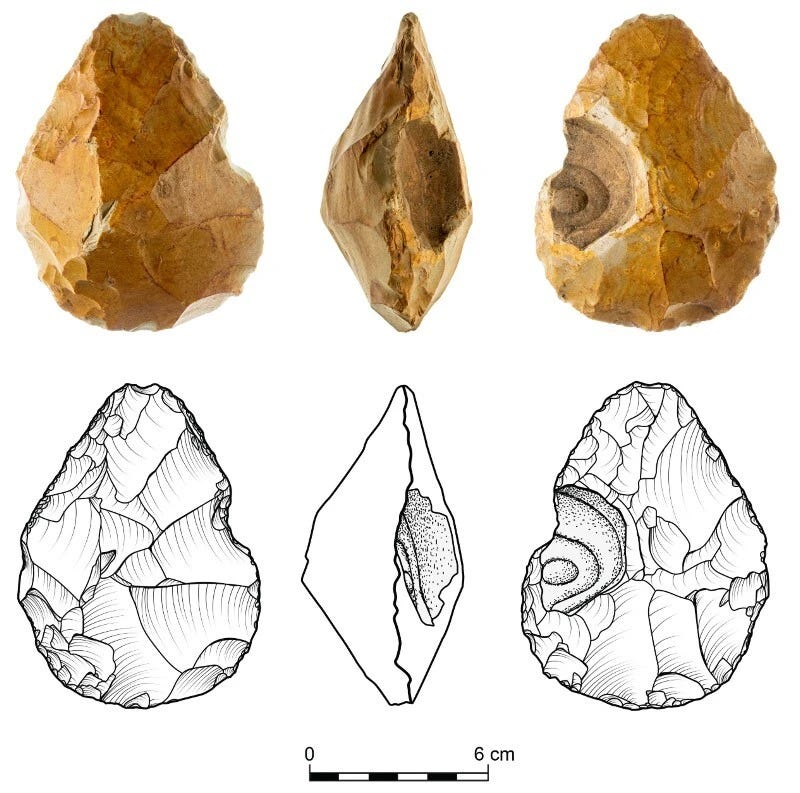
Barkai and Shalata, writing in Tel Aviv: Journal of the Institute of Archaeology of Tel Aviv University,1 argue that the concentration is not coincidental. Pristine, unflawed flint nodules were abundant throughout the valley. The knappers had no shortage of good stone. The nodules with embedded features were a small subset of what was available, and yet they were selected, reduced into handaxes, and worked in a way that preserved the feature and placed it prominently. Almost none of the knapping waste recovered during the survey — the flakes, cores, and debris from tool production — shows any fossils or geological inclusions. The features appear almost exclusively on finished handaxes. That asymmetry is hard to explain as accident.
The fossils in the nodules are difficult to identify precisely from surface specimens. One appears to be a marine invertebrate, possibly a Nerinea, Baculites, or Crinoidea. Another shows what may be a beekite, a silicified geological concretion. Others incorporate geodes, hollow spherical rocks lined with quartz crystals that occur throughout the Sakhnin Valley landscape in unusual abundance. One handaxe was worked from a nodule containing multiple geodes; another preserves a geode inclusion visible at the tool’s edge and midsection. Two bifaces have deep natural hollows on one face that the researchers describe, with acknowledged uncertainty, as reminiscent of caves.
The survey also recovered what may be the most remarkable single object from the site: a spheroid — a shaped stone ball of the kind common in Acheulean assemblages, typically made of flint or limestone and used for heavy tasks including bone-breaking — made not from flint but from a geode. Flaking a geode is genuinely difficult. The outer crust resists in ways that ordinary flint does not, and controlling the reduction sequence requires skill. Someone at Sakhnin Valley went to the considerable trouble of making a standard Acheulean tool type out of a material that made the task much harder. The team can see no utilitarian reason for it.


