
Sanxingdui already had plenty of extraordinary objects before anyone knew what the fragment in Pit No. 7 actually was. The site in Sichuan Province had produced bronze masks with protruding eyes, bronze trees several meters tall, figurines unlike anything else in the ancient Chinese world. It was, by any measure, a place where the people of the late Shang Dynasty did strange and impressive things. So one more odd piece of metal did not immediately announce itself.
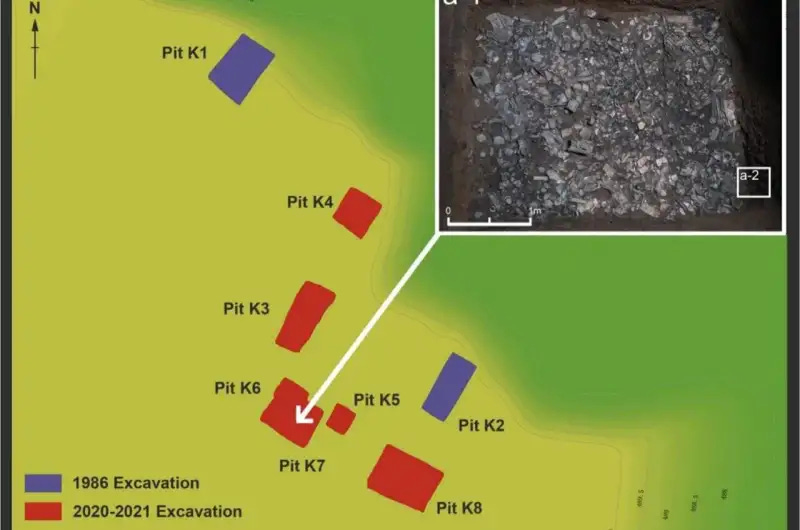
The object in question is now catalogued1 as K7QW-TIE-1: an axe-like tool or weapon, roughly 20 centimeters long and broken into three fragments. It looks utilitarian. It is not.
Metallographic analysis and scanning electron microscopy combined with energy dispersive spectroscopy revealed that the artifact’s nickel-iron composition was chemically homogeneous in a way that would have been essentially impossible to achieve through smelting. Late Shang metallurgists were capable ironworkers in certain respects, but the level of homogeneity here exceeds what known technology of the period could plausibly produce. The iron came from somewhere else entirely — from a meteorite.
That makes it the earliest Bronze Age meteoritic iron artifact yet identified in southwestern China, and the largest meteoritic iron artifact found anywhere in the country.


