

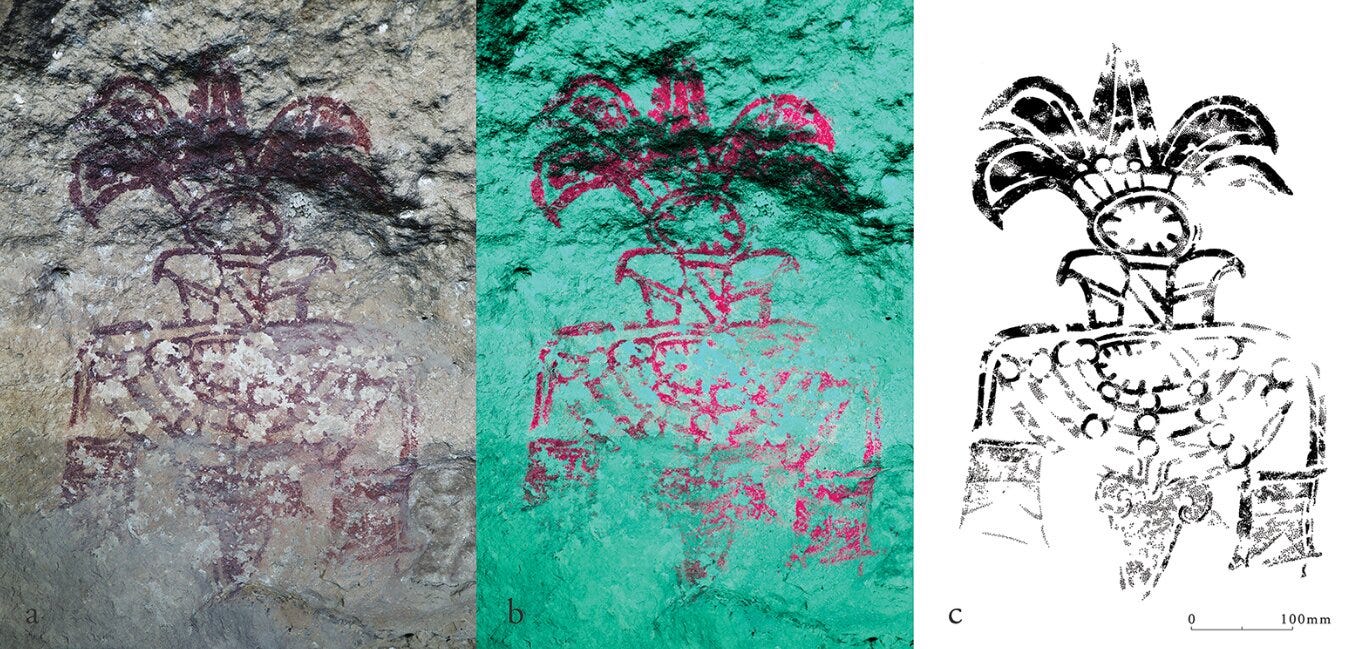
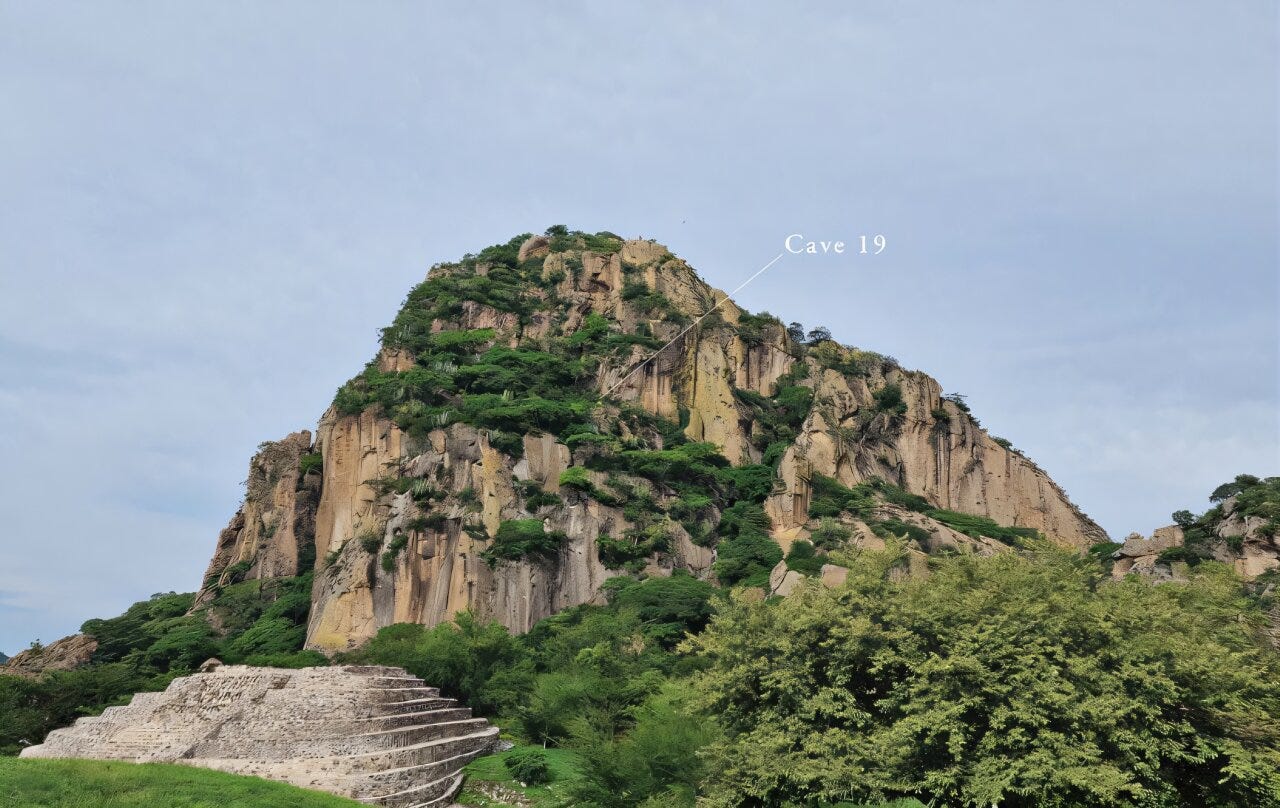
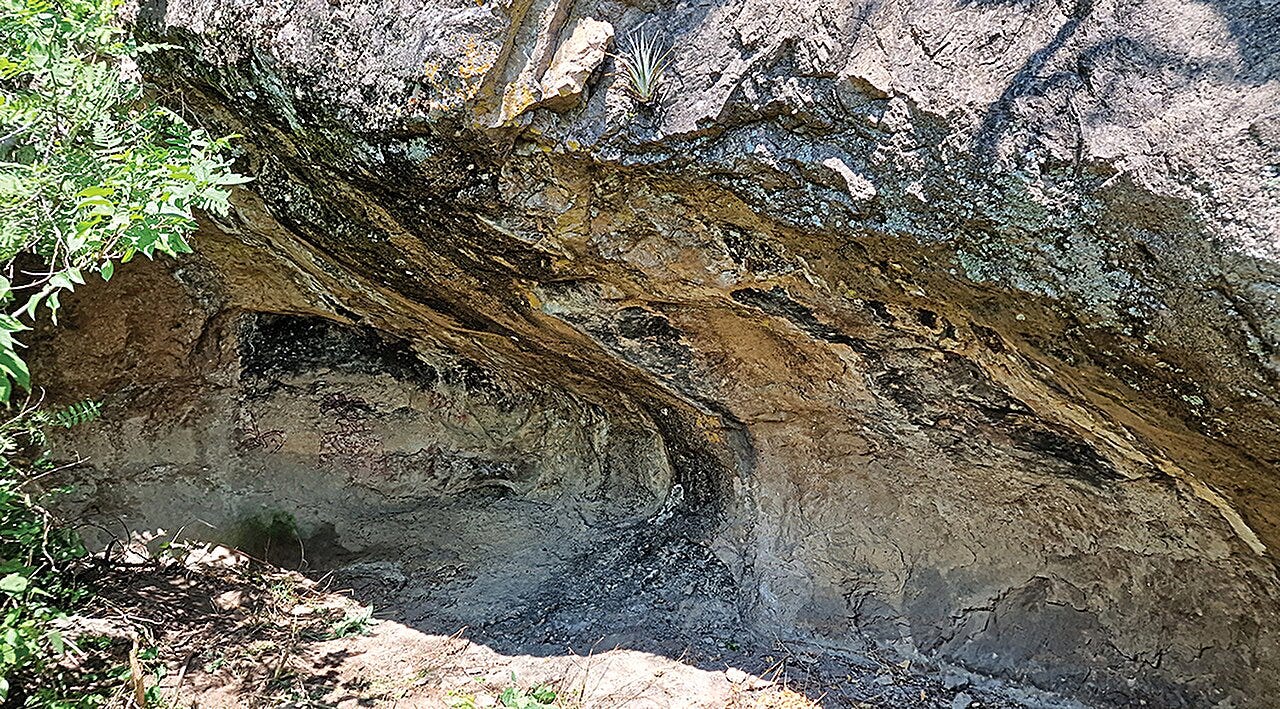
On the western face of Cerro Delgado, a 110-metre hill of volcanic rock in the Mexican state of Morelos, there is a rock shelter that nobody can walk to anymore. The team that recorded it in August 2022 climbed the hill from its gentler eastern side and abseiled down the cliff, and they suspect that in antiquity people reached it from below on scaffold-like ladders, using footholds that someone chipped into the steeper stretches of rock. Archaeologists call it Cave 19, though it barely qualifies as a cave: it is 5.43 metres wide and at most 2.24 metres deep, and the lip of rock overhead hangs between 1.46 and 1.85 metres above the floor, low enough that a tall visitor stoops. At the back, above a bedrock shelf blackened by old fire, someone sometime between the fourth and sixth centuries AD took a brush and dark red pigment, probably haematite, and painted three designs. Two of them are signs from the script of Teotihuacan, the metropolis northeast of modern Mexico City, in a form of Teotihuacan writing that a good many specialists spent the twentieth century insisting was not really writing at all.
That insistence had respectable sources. Joyce Marcus, in her 1992 survey of Mesoamerican writing systems, and Esther Pasztory, in her 1997 book on the city, both characterised Teotihuacan as a state without a true script, and the vocabulary that grew up around its signs did the same work more quietly. James Langley, who catalogued the signs in the 1980s, spoke of a “notational system” and of “emblematic glyphs,” terms that placed Teotihuacan a rung below the Classic Maya and the Aztecs, whose hieroglyphs everyone agreed recorded language. The German epigrapher Thomas Barthel saw the danger in 1987, warning that a purely visual reading tempts scholars to treat the signs like airport pictograms. The suspicion was not unreasonable, because Teotihuacan texts are short, usually a single glyphic compound, and the city left no long carved narratives of kings and wars of the kind that made Maya decipherment possible.
The new paper on Cave 19, published in Antiquity1 by Christophe Helmke and Jesper Nielsen of the Institute of Cross-cultural and Regional Studies at the University of Copenhagen, with Carolina Meza Rodríguez and Mario Córdova Tello of Mexico’s Instituto Nacional de Antropología e Historia (INAH), takes the opposite position as settled. Drawing on a run of papers by the authors and by Karl Taube, they describe a logo-phonetic script comparable to Maya and Aztec writing, with a repertoire they now estimate at almost 120 signs, in which researchers have identified calendar notations, place names, personal names, titles and even verbs.
Which is why a painting not much bigger than a dinner plate, on a cliff far from the city, matters more than its size suggests. A script shows itself in the way its signs behave: the same compound should mean the same thing wherever it turns up, whether on an apartment-compound wall in the city or in a shelter on a hill in Morelos. Terse texts give the skeptics little to test, so every example found outside the metropolis is a chance to check whether the signs travel with their meanings intact. Cave 19 offers something close to that test, because one of its glyphs appears to name a place that is also named in a mural inside Teotihuacan.


