

The atlatl is an old piece of equipment. Not old in the way a well-used tool feels old, but old in the way that makes you pause when you hold one — an apparatus for throwing that predates agriculture, predates pottery, predates writing by tens of thousands of years. A shaft, a hook, a dart. The physics are simple: it extends the thrower’s arm, acting as a lever to multiply the force delivered to the projectile at release. Used well, it can send a dart through a bison’s ribcage at forty meters.
At some point in the past, people started using bows instead. The mechanics are different — elasticity rather than leverage, a bent limb storing and releasing energy rather than an arm extended by a stick. Arrows are smaller, faster, more accurate at range, and can be launched from a crouch or on horseback without advertising your position. By any straightforward comparison of ballistic performance, the bow looks like the obvious upgrade. Which makes it strange that for a long time, archaeologists couldn’t agree on when it actually arrived in North America, or how fast it spread once it did.
The estimates ranged wildly. Some researchers argued the bow reached the far north as early as 12,000 years ago. Others placed its arrival in the Great Basin between 1,800 and 1,500 years before present. A few proposed that Folsom hunters of the late Pleistocene Southwest were already using it. The problem wasn’t a shortage of theories. It was a shortage of direct evidence.
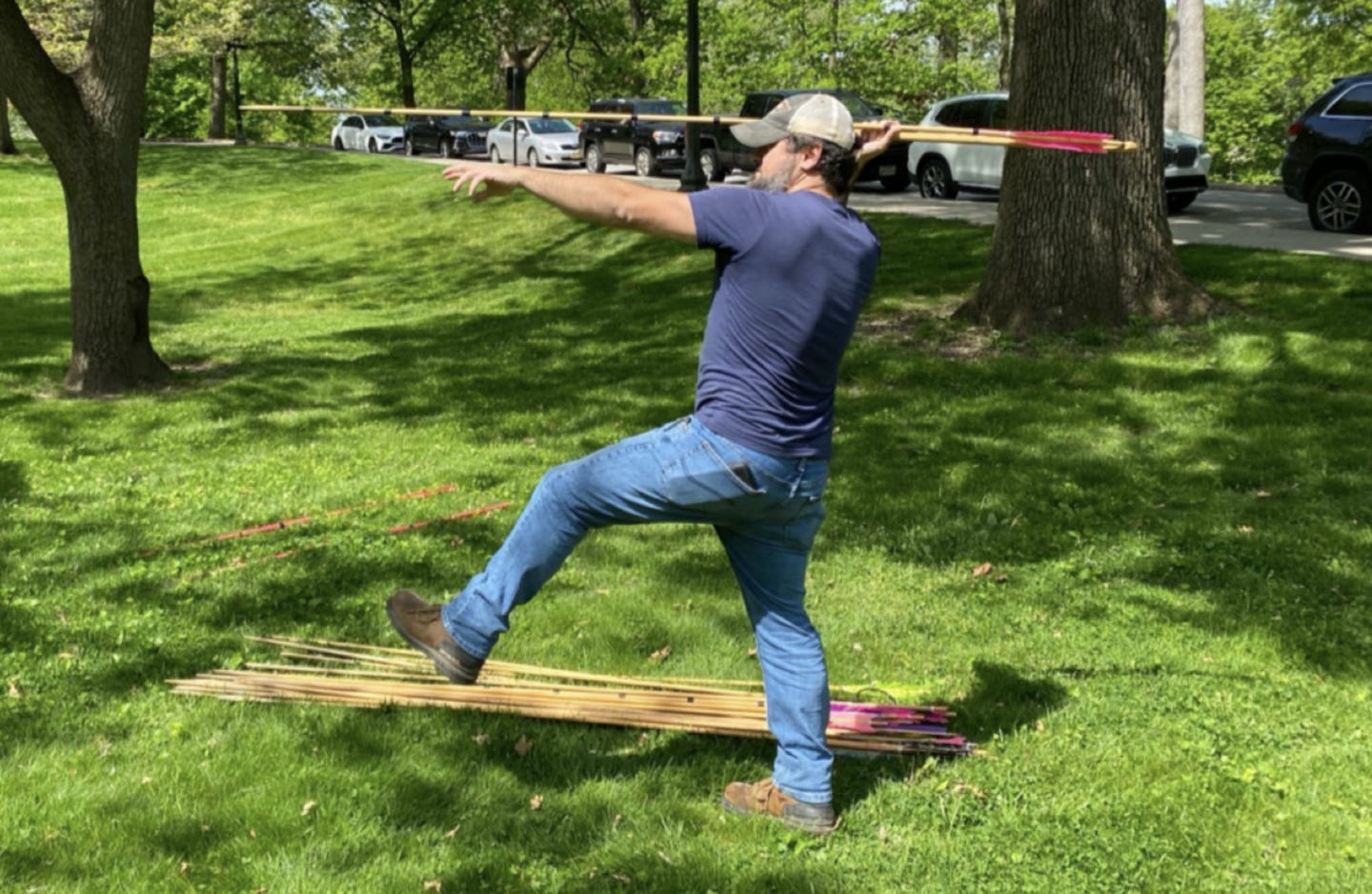
Most weapons don’t survive. Atlatls and bows are wood, sinew, and hide. Arrows are cane or willow. What the archaeological record usually preserves is the stone tip, and stone tips present a genuine interpretive problem: the same general class of point can be used on a dart or an arrow, and distinguishing between them requires assumptions about size and weight that archaeologists still argue about. The delivery system — the part that actually tells you what kind of weapon you’re dealing with — almost never makes it to the present.
Almost never. There are exceptions, and they cluster in specific environments: dry caves in the Southwest, and more recently, the margins of melting glacial ice patches in the Yukon and Northwest Territories, where organic materials have been locked in cold storage for centuries and are now emerging as the ice recedes.
What the Ice Kept
A team led by Briggs Buchanan of the University of Tulsa compiled1 radiocarbon dates from 136 preserved organic weapons recovered across western North America — actual bows, actual arrows, actual atlatls and darts, objects whose identity doesn’t need to be inferred from tip morphology. The sample spans roughly 10,000 years and stretches from northern Mexico to Alaska. Using this dataset, the team applied three analytical methods: chronological modeling, optimal linear estimation to identify when bow technology first appears in the record, and Bayesian logistic regression to model the shape of the transition from atlatl to bow over time.
Their central finding is clean: bow technology appears around 1,400 years ago in both the northern and southern regions of their study area. Not 5,000 years ago. Not 8,500 years ago. Fourteen hundred. The timing aligns so closely in both regions that the most parsimonious explanation isn’t parallel invention — it’s a single origin followed by rapid diffusion through existing cultural transmission networks.
This matters because the previous picture was messier. Several researchers had proposed temporal gradients, with the bow trickling south from an Arctic origin over thousands of years. The organic weapon data don’t support that model. Instead, something that looks more like a pulse: the technology appears nearly simultaneously across an enormous and ecologically varied swath of the continent, then plays out differently depending on where it landed.


