
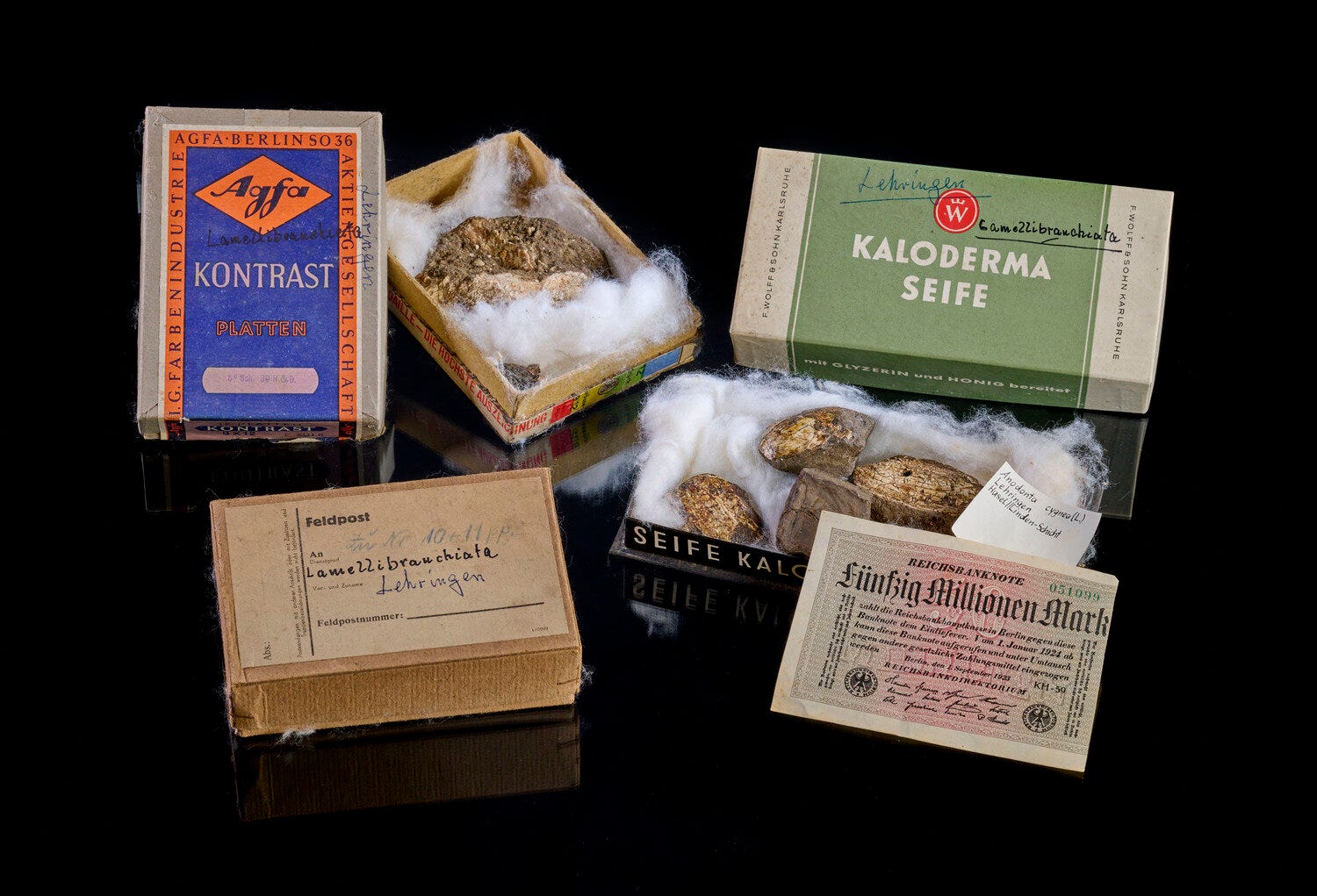
In 1948, a small team of amateur excavators working a marl quarry near the village of Lehringen in Lower Saxony pulled a wooden spear from sediments laid down during the last interglacial. It was 2.38 meters long, made from yew, still in one rough piece, and it had been lying between the ribs of a straight-tusked elephant (Palaeoloxodon antiquus) for approximately 125,000 years. No photographs of the original find position exist. Neither do reliable drawings. The site was a commercial fertilizer operation, not a planned excavation, and the team did the best they could under the circumstances.
The find became world-famous anyway. Lehringen entered the literature as the clearest possible case of Neanderthal elephant hunting: a complete wooden weapon, the first ever found from a Middle Paleolithic context, lying in anatomical association with the largest land mammal known to have lived in Pleistocene Europe. The picture was compelling. Then the skeptics arrived.
The problems were real. The spear’s tip showed use-wear traces that left open the possibility it functioned as a multi-purpose tool, perhaps a digging implement or a snow probe rather than a hunting weapon. More troublingly, some researchers argued the spear might have washed into proximity with the carcass at the margins of the paleo-lake, a coincidental association rather than a killing blow. Without proper documentation, there was no way to definitively rule this out. For decades the site existed in an interpretive limbo: famous, referenced constantly, but not quite settled.
A study published this year in Scientific Reports1 by Ivo Verheijen, Gianpiero Di Maida, Gabriele Russo, and Thomas Terberger represents the first systematic zooarchaeological analysis of the Lehringen faunal assemblage. Their findings do not simply shore up the hunting hypothesis. They reframe the site altogether.
What the bones say
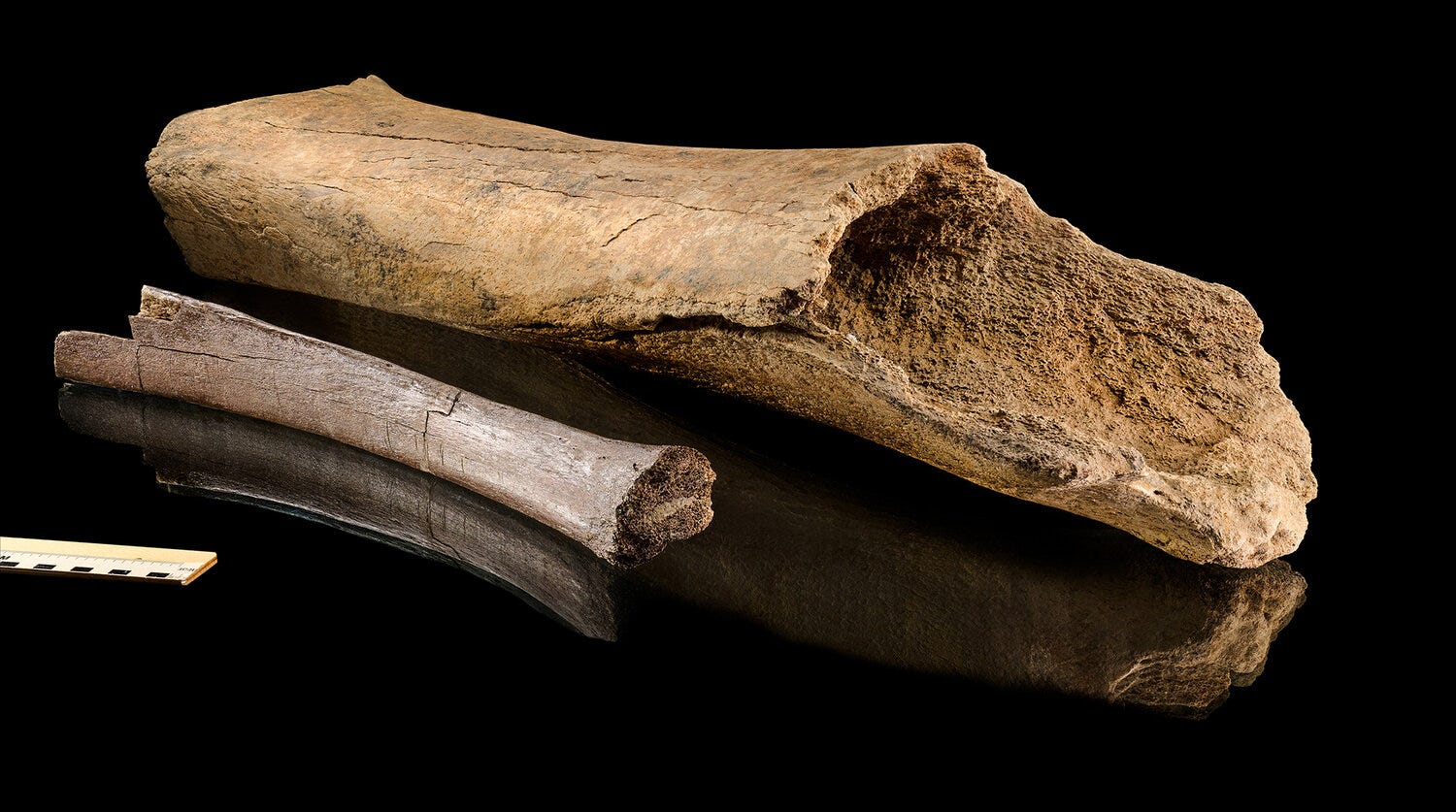
The elephant at Lehringen was a male, probably around 30 years old, based on molar wear. Not yet fully grown, but already large. His long bone epiphyses were still unfused, consistent with that age estimate. His death from natural causes is unlikely: the analysis found only minor pathologies to the vertebral column, and an animal in the prime of life at this size would not simply die at a lakeshore and then happen to have a spear fall beside him.
The key evidence is on the ribs. Seven ribs or rib fragments carry cut marks. Most of these are on the lateral surface, perpendicular or diagonal to the long axis of the bone, consistent with filleting meat from the rump. That alone would support butchery, not hunting. But one rib fragment carries something more diagnostic: a series of cut marks on its internal face, the surface that faces inward toward the chest cavity. Cut marks on the internal face of a rib have a specific meaning. To make them, someone had to be working from inside the thorax. The carcass had to be fresh. The organs were the target.
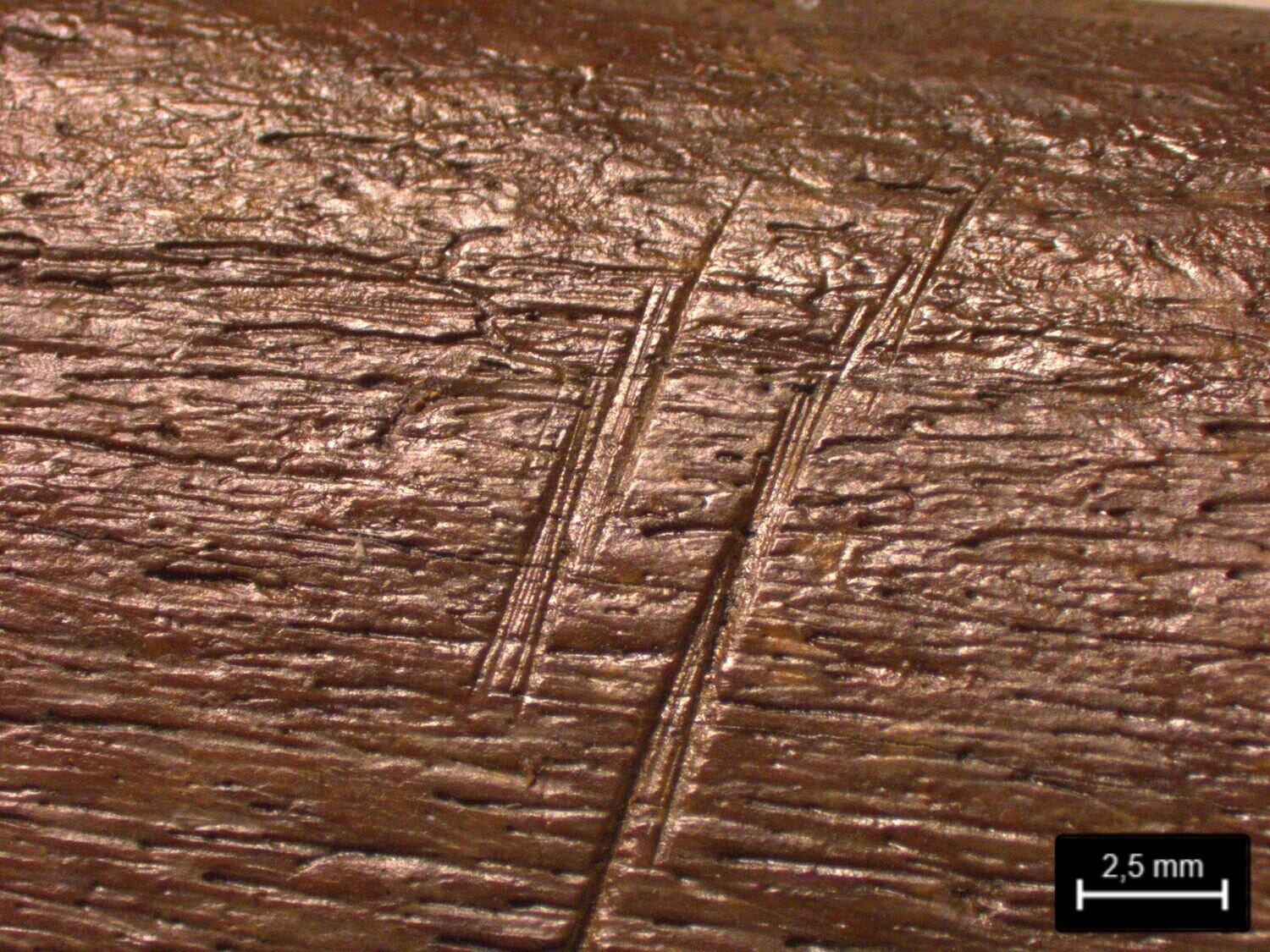
This matters because access to the internal organs requires primary access to the carcass, before carnivores have opened it, before any substantial decomposition. The cut marks on the inner rib surface indicate the elephant was eviscerated while still in a state that made the organs worth recovering. The researchers note that carnivore gnawing is present on the distal ends of ribs and the dorsal spines of vertebrae, but it is limited. The bone surface shows no significant weathering. The picture is not of a carcass opportunistically encountered and partially scavenged. It is of a fresh animal, butchered by hominins who got there first.
The lithic assemblage, 25 Baltic flint flakes recovered near the elephant’s skull, reinforces this. Use-wear analysis on some of these pieces is consistent with defleshing activity. No cores were recovered, which probably means the knapping happened elsewhere. These were working tools, brought to the carcass.
No direct evidence of spear impact was found on the elephant’s skeleton. No wound channel, no bone lesion attributable to a thrown or thrust weapon. The absence is not definitive: soft tissue injuries leave no skeletal trace, and an animal struck in the flank or neck might show nothing on the bones that survived. The spear between the ribs remains the most literal association of weapon and prey in the Paleolithic record, and the fresh-carcass evidence, the prime-age male, the lithics with butchery wear, and the lack of any plausible alternative explanation for the elephant’s death all point in the same direction.
A wider spectrum
The elephant is not the only story at Lehringen. The site preserves faunal remains from multiple stratigraphic layers spanning different phases of the Eemian interglacial. What the new analysis makes clear is that Neanderthals were not visiting this lakeshore once for a single spectacular kill. They were coming back, exploiting whatever was available.
Aurochs (Bos primigenius) remains represent at least three subadult individuals, recovered from the basal peat layer beneath the marl that contains the elephant. The remains of the most complete individual include cut marks on the lateral ramus of a mandible and on a lumbar vertebra, indicating defleshing. Carnivore gnawing, probably from wolf, is also present on the aurochs bones, suggesting that other predators were working these carcasses too, though whether before or after Neanderthal butchery cannot be determined.
A single brown bear (Ursus cf. arctos) is represented by two bones: a rib fragment and a distal femur. Both show anthropogenic modification. The rib carries cut marks on its external surface, consistent with filleting. The femur shows cut marks from filleting on both faces, and also impact marks with cone fractures on the shaft. Someone fractured that femur to access the marrow. Brown bear femora contain substantial marrow fat, particularly relevant in late summer and autumn when bears are at maximum fat deposition. The researchers note that bears, beavers, and elephants share a common dietary appeal: high fat content. This may not be coincidental.
The beaver (Castor fiber) evidence is the most anatomically detailed. Pelvis fragments, skull elements, and mandibular pieces all carry traces of human activity. Cut marks on the ilium suggest disarticulation at the hip joint. Marks on the maxilla, near the zygomatic arch, are positioned to indicate severance of the masticatory musculature, perhaps to detach the mandible. Marks on the lateral surface of a mandible fragment are consistent with skinning. Beaver fur is dense and waterproof. That the Lehringen Neanderthals were skinning beavers, not just butchering them for meat, fits with documented patterns at other Middle Paleolithic sites including Krapina in Croatia and Taubach in Germany, and goes back even earlier at Bilzingsleben, where both the European beaver and the giant beaver (Trogontherium cuvieri) were being processed with stone tools.
The breadth of prey at a single open-air lakeshore site is what stands out. Palaeoloxodon antiquus, a megaherbivore weighing several tons. Bos primigenius, large and dangerous. Ursus cf. arctos, a bear. Castor fiber, a semi-aquatic rodent valued for both its flesh and its pelt. The assemblage also preserves wels catfish (Silurus glanis), pike (Esox lucius), pond turtles, herons, cormorants, deer of multiple species, rhino, wolf. Not all of these were prey. But the lake environment clearly concentrated resources in ways that Neanderthals recognized and returned to.
The researchers interpret this as opportunistic procurement rather than specialized hunting. The contrast is with sites like Mauran and La Borde in France or Salzgitter-Lebenstedt in Germany, where large numbers of a single prey species point to targeted, probably organized drives or ambushes. At Lehringen, the diversity of exploited species and the absence of large numbers of any one taxon suggest a different mode: taking what the landscape offered, across multiple visits, from the full range of what the Eemian interglacial around a paleo-lake could provide.
The spear itself
The Lehringen thrusting spear deserves its own moment. Made from yew (Taxus sp.), from the trunk rather than a branch, it required the removal of up to 39 knots and side branches. That is not a weapon thrown together at a kill site. Yew was not a random choice either: the wood is flexible and strong, properties that matter in a thrusting weapon that needs to absorb impact without shattering. The time investment in its production implies forward planning and a clear conception of what the tool was for.
The spear shows extensive use-wear, suggesting it had been used repeatedly before ending up at Lehringen. Its current curved shape is a result of post-depositional deformation, probably from the overlying weight of the elephant and sediment. Some researchers suggested that curvature and use-wear indicated it might have served other functions, including digging, and this remains technically possible. But a digging stick is not what you build from a carefully trimmed yew trunk with a hardened point and 39 removed branches.
The spear was recovered in seven pieces and is currently broken into eleven, all of which fit together. It is held in Hanover, preserved in beeswax, and remains one of the most extraordinary objects from the Paleolithic record anywhere in the world.
What Lehringen offers now, with a proper zooarchaeological foundation under it, is a site that actually supports what the 1948 discovery seemed to show. Neanderthals hunted a straight-tusked elephant. They butchered it fresh, opening the chest cavity to reach the organs. They made the tools to do it, brought them to the lakeshore, and left traces on bones that have lasted 125 millennia in remarkably good condition. They also came back, or never left, hunting aurochs from the peat below the elephant and processing bear and beaver on other occasions. The lake was a resource concentration point, and they knew it.
Further Reading
Gaudzinski-Windheuser, S., Kindler, L., MacDonalds, K., & Roebroeks, W. (2023). Hunting and processing of straight-tusked elephants 125,000 years ago: Implications for Neanderthal behaviour. Science Advances, 9, eadd8186.
Gaudzinski-Windheuser, S., Kindler, L., & Roebroeks, W. (2023). Widespread evidence for elephant exploitation by Last Interglacial Neanderthals on the North European plain. Proceedings of the National Academy of Sciences, 120(50), e2309427120.
Thieme, H., & Veil, S. (1985). Neue Untersuchungen zum eemzeitlichen Elefanten-Jagdplatz Lehringen, Ldkr. Verden. Die Kunde, N. F., 36, 11–58.
Gaudzinski-Windheuser, S., Kindler, L., & Roebroeks, W. (2023). Beaver exploitation, 400,000 years ago, testifies to prey choice diversity of Middle Pleistocene hominins. Scientific Reports, 13, 19766.
Kindler, L., et al. (2025). Large-scale processing of within-bone nutrients by Neanderthals, 125,000 years ago. Science Advances, 11, eadv1257.
Schoch, W. H. (2014). Holzanatomische Nachuntersuchungen an der eemzeitlichen Holzlanze von Lehringen, Ldkr. Verden. NNU, 83, 19–29.
Verheijen, I., Di Maida, G., Russo, G., & Terberger, T. (2026). Faunal exploitation at the elephant hunting site of Lehringen, Germany, 125,000 years ago. Scientific Reports, 16, 9836. https://doi.org/10.1038/s41598-026-42538-4


