

Seventy-seven headless skeletons have been excavated from a ditch at the edge of a 7,000-year-old farming village in southwestern Slovakia. They are lying at the bottom of the ditch in no particular order — prone, supine, twisted, limbs splayed or folded under bodies, some overlapping others. No grave goods accompany them. Their skulls are simply gone.
The site is Vráble-Veľké Lehemby, in the Nitra District, and it belongs to the Linear Pottery culture — the Linearbandkeramik, or LBK — the earliest farming tradition to spread across central Europe. Researchers from Kiel University and the Slovak Academy of Sciences have been excavating it since 2012. The settlement itself is substantial: at least 313 houses, grouped into three spatially distinct neighbourhoods, occupied roughly between 5250 and 4950 BCE. One neighbourhood is enclosed by a double ditch 1.3 kilometres long with at least six entrances. The headless skeletons were found in that ditch, concentrated near one of its entrances, at the bottom of the outer earthwork.
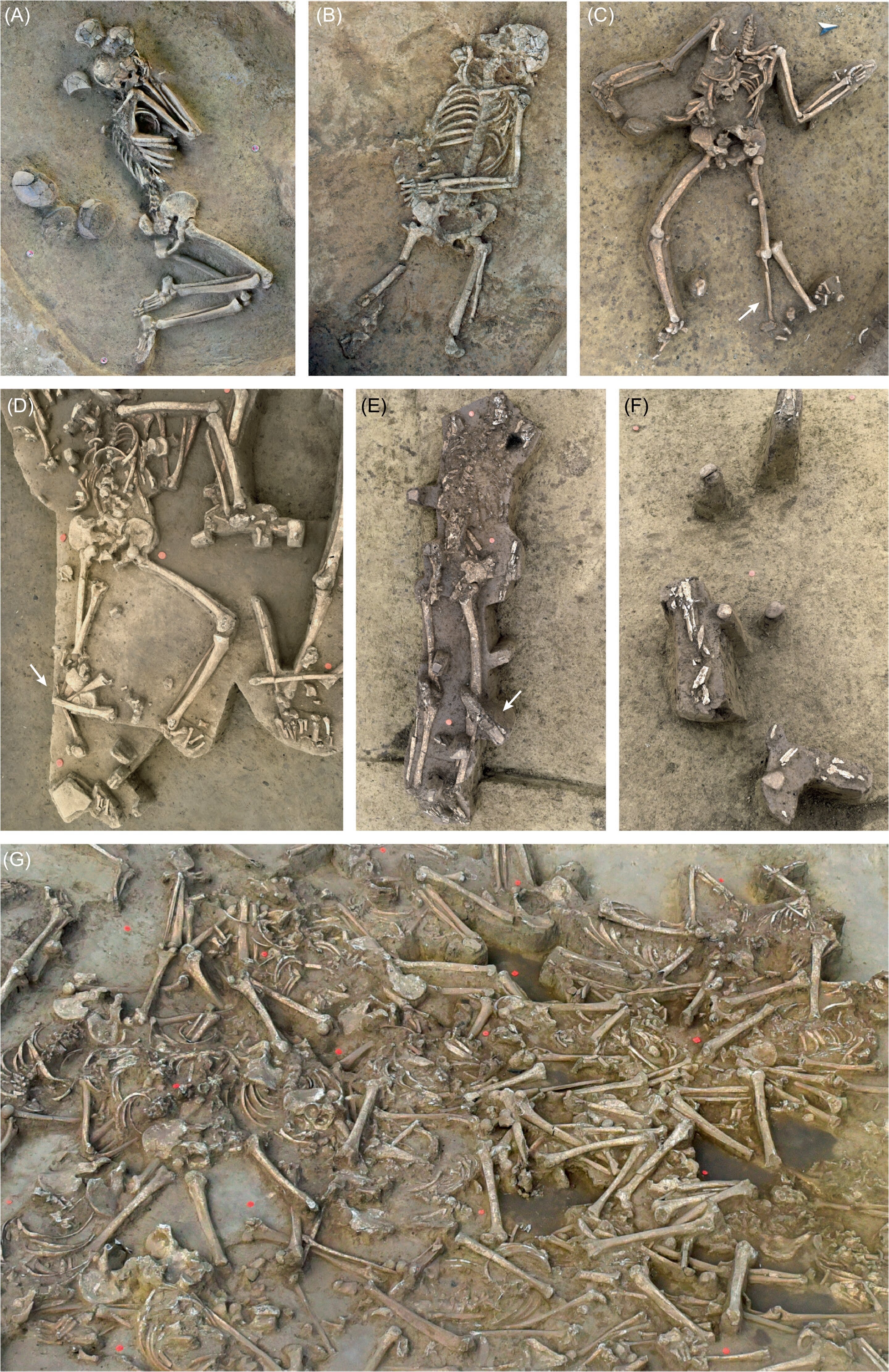
What has accumulated since fieldwork expanded in 2022 is now the subject of a paper by Martin Furholt and colleagues published in the Proceedings of the Prehistoric Society.1 The find is extraordinary not just for the numbers — 77 headless individuals, with only a single child’s skeleton still possessing a skull — but for what it resists. The first instinct, understandably, is to reach for the massacre explanation. That instinct, the researchers argue, is probably wrong.


