
Somewhere in the storage rooms holding material from Natufian excavations in Israel, there were bags of clay lumps. About 40 kilograms of them, collected from sieved sediment at sites including Eynan-Mallaha, el-Wad Terrace, and Hayonim Terrace. They had been sitting there, largely uninvestigated. The working assumption was that they represented some form of pigment processing — heat-treated iron-rich clays, nothing more.
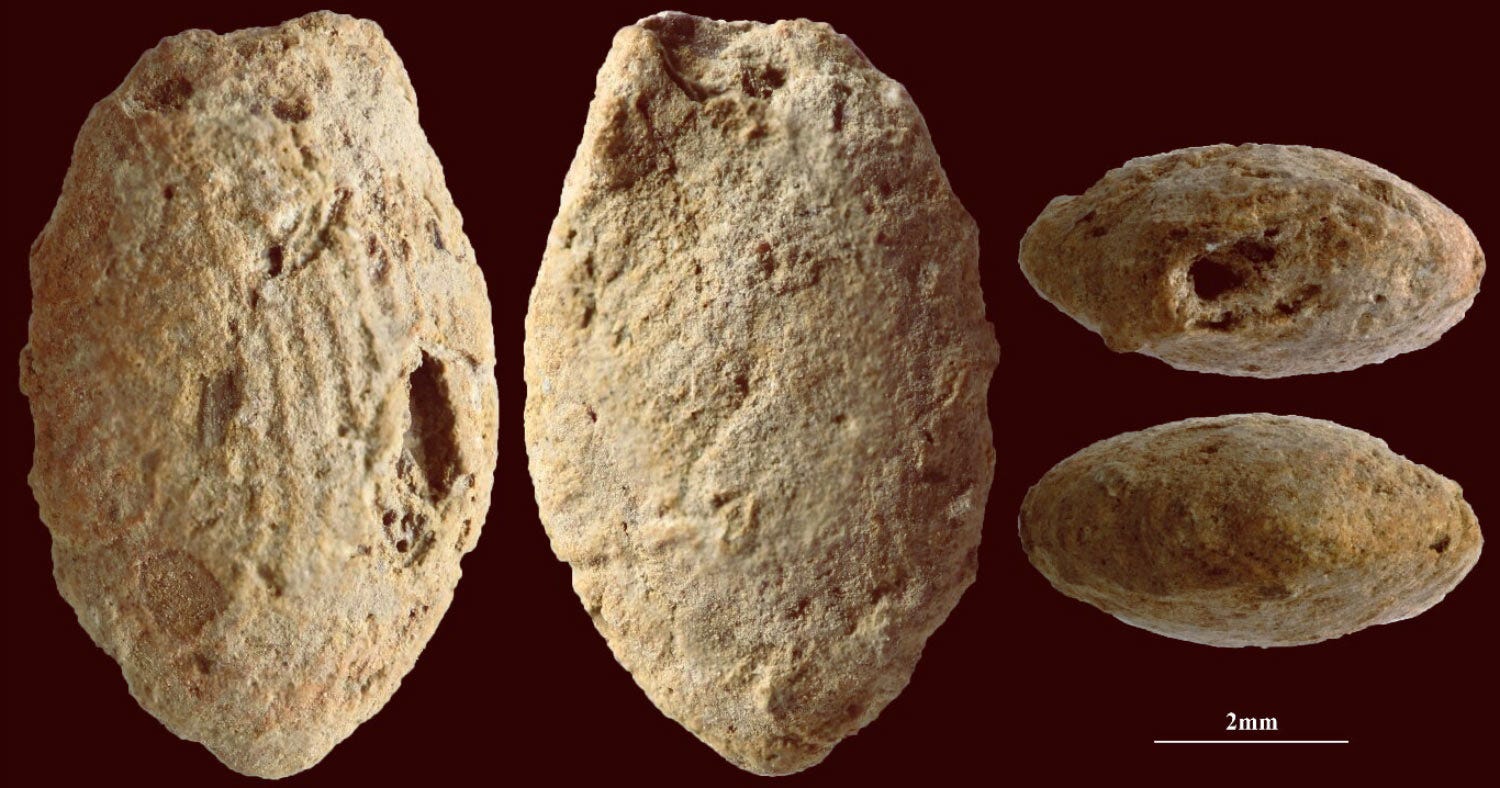
When a team led by Laurent Davin finally sorted through them, they found something nobody expected. Among the lumps were 142 beads and pendants made of clay, spanning the full duration of the Natufian culture, from the Early Natufian around 15,000 years ago through the Final Natufian at roughly 11,650 calibrated years before the present. The study, published this week in Science Advances,1 reports the earliest known clay ornamental tradition outside of Europe — and one of the most unusual windows into who was making things, and why, at the moment Homo sapiens in the Levant was first settling down.
The Natufian is one of the genuinely strange episodes in the human story. These were hunter-fisher-gatherers who built stone architecture, buried their dead with elaborate funerary assemblages, kept dogs, played bone instruments that apparently imitated raptor calls, and wore extraordinary quantities of shell beads. A woman buried at Eynan-Mallaha had 435 beads on her body. That’s more than the entire ornament count from most mobile camps of the preceding Upper Paleolithic periods. The shift from sparse, relatively static ornamental traditions to this extraordinary proliferation happened abruptly, over a few thousand years, as people stopped moving and started staying in one place. The Natufians were not yet farmers, but they were the first people in Southwest Asia to be genuinely sedentary, and that change seems to have accelerated something in the symbolic life of these communities.
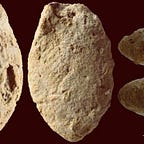
The clay beads had been invisible partly because of their material. Unbaked clay doesn’t survive well in the ground. The ornaments preserved here were saved by accidental heat exposure — hearth fires, burnt structures — which hardened them just enough to make it through the millennia. This is the standard problem with early clay use: the record is almost certainly much richer than what survives. Even knowing that, what the team recovered is striking. They identified 19 distinct morphological types, including elliptical beads (the most common, at 44% of the corpus), cylindrical beads in five different formats, disk beads in multiple sizes, spheroid beads, ovoid pendants, and circular pendants of varying scale. Some of these forms were tiny and discreet. Others were ostentatious: one large disk bead from el-Wad Terrace measured nearly 20 square centimeters in surface area. That is not a quiet piece of jewelry.


