
The View from the Furrows
For generations, Samos has been cast as a maritime star. Ancient authors praised its ships, its traders, its reach across the Aegean. But if you leave the harbors and climb into the low hills of the island’s southwest, that story begins to thin out.
Here, the evidence does not arrive as temples or shipwrecks. It comes as pottery fragments, sun-bleached and broken, scattered across plowed fields and terraces. More than 1,300 of them.
Taken one by one, these sherds say very little. Taken together, they redraw the map of daily life.
Walking the Island, Step by Step
Archaeology Without Trenches
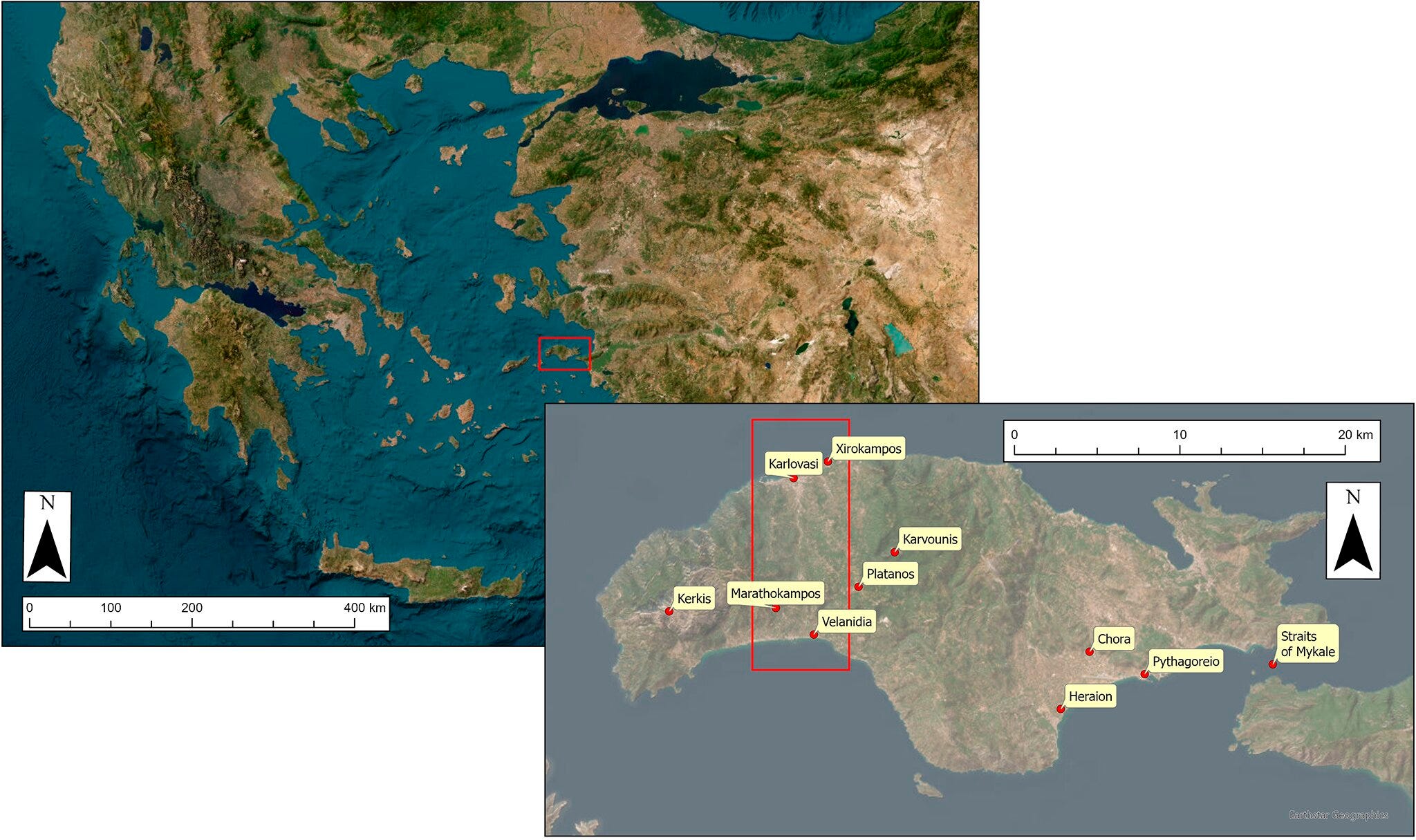
Between 2021 and 2024, researchers from the West Area of Samos Archaeological Project1 did something deceptively simple. They walked.
Systematically. Repeatedly. With GPS units, tablets, drones, and an almost stubborn patience for detail. The team combed the southwest of the island through intensive pedestrian survey, recording every diagnostic fragment2 they could see.
As the project team puts it:
“The primary aim was to identify areas of ancient activity through a combination of exploratory and systematic investigations of the landscape.”
This kind of archaeology works outward rather than downward. Instead of digging into one site, it lets patterns emerge across kilometers of land.
Fifteen Places That Would Not Stay Quiet
The survey identified fifteen Areas of Interest, clusters where surface material hinted at repeated human activity. These were not fleeting campsites. The ceramics span centuries, from the Archaic period through Byzantine times.
The hillsides around Marathokampos, Velanidia, and Limnionas turned out to be busy places for a very long time.
Pots That Tell a Local Story
An Inward-Facing Economy
When the ceramics were sorted and studied, a surprise emerged. Most of the pottery was local. Not just made nearby, but made for nearby.
Imported wares were rare. Amphorae tied to long-distance trade appeared only in small numbers. Instead, everyday vessels dominated the assemblage.
The researchers summarize it plainly:
“The ceramics suggest a largely inward-facing economy, dominated by locally produced wares.”
This does not contradict Samos’ reputation as a trading island. It complicates it. Ships may have carried Samian goods across the sea, but the people in these hills lived on what they grew, stored, cooked, and consumed themselves.
Farming the Slopes
The landscape helps explain why. Southwest Samos is rugged but generous. Terraces cling to hillsides. Streams cut through basins. Olive trees and vines still follow ancient contours.
Historical sources describe olives, wine, legumes, figs, livestock, and honey. The archaeological record now shows how deeply those activities were embedded in rural life.
Ports, Paths, and Changing Centers
From Seasonal Shore to Permanent Settlement
One of the most intriguing patterns is how settlement shifted over time. In some coastal areas, light seasonal use slowly thickened into permanent occupation. Small port-side installations became villages.
The pottery tracks this change. Early scatters give way to denser, more varied assemblages that signal households, storage, and continuity.
Networks That Ran Inland
The team also used GIS and route modeling to understand how people moved between coast and interior. The result is a picture of connectivity that does not rely on ships alone.
Paths, ridges, and valleys linked farms to ports, ports to villages, and villages to one another. Maritime trade mattered. But it rested on a quiet, resilient rural backbone.
As the project notes:
“Rural communities functioned alongside maritime centers, forming a complex but regionally rooted network.”
Why This Matters
It is easy to romanticize the ancient Mediterranean as a world of sails and empires. The pottery of southwest Samos pushes back.
Most people did not live at the docks. They lived uphill, tending terraces, repairing jars, feeding families. Their economy was not global. It was dependable.
By letting broken ceramics speak, this project gives voice to those lives.
Summary
The West Area of Samos Archaeological Project reveals a side of ancient Samos long overshadowed by its maritime fame. Intensive surface survey shows that southwest Samos supported a durable, largely self-sufficient rural economy for centuries. Local pottery dominates, settlement patterns shift gradually, and inland networks prove as vital as seaborne trade. The result is a richer, quieter history of how island life actually worked.
Christophilopoulou, A., Huy, S., Loy, M., Mac Sweeney, N., & Mokrišová, J. (2025). The West Area of Samos Archaeological Project: Results from south-west Samos. The Annual of the British School at Athens, 1–61. https://doi.org/10.1017/s0068245425100245
Loy, M., Argyraki, K., Christophilopoulou, A., Delli, G., Evans, M., Huy, S., Katevaini, A., Mac Sweeney, N., Mokrišová, J., Regazzoni, E., & Vasileiou, A. (2025). Field data from the west area of Samos archaeological project (WASAP), 2021–2024. Journal of Open Archaeology Data, 13(9). https://doi.org/10.5334/joad.156


