

Among the tombs at the Imdang-Joyeong burial complex in Gyeongsan, southeastern Korea, at least twenty have two chambers. One is rectangular, the main compartment, where the grave owner was interred. The other is square and subsidiary, positioned directly adjacent. Both contain human remains. The subsidiary chamber holds only sacrificed individuals — people killed to accompany the dead, a practice Silla historical records call Sunjang. In some graves the sacrificed appear in both chambers. In two main chambers, archaeologists found as many as five.
More than 1,600 graves have been identified at the complex, and human remains from 259 individuals have been recovered since excavations began in 1982. The tombs date from the fourth to the sixth centuries CE, a span corresponding to roughly three or four human generations. Their owners were local elites, descended from the rulers of Abdok, a small state absorbed into Silla in the fourth century. Sunjang was prohibited by royal decree in 502 CE. The burials at Imdang-Joyeong end not long after.
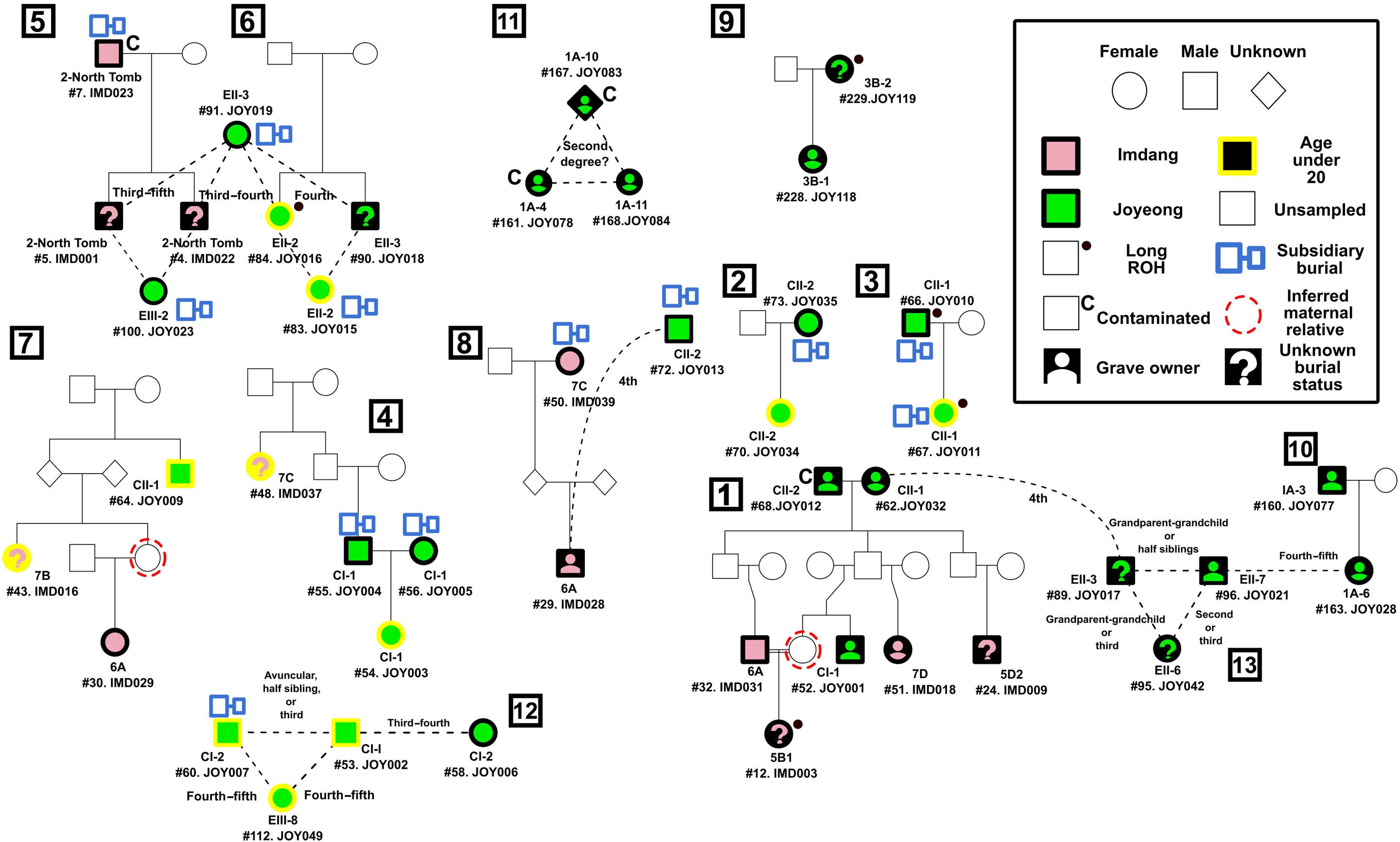
In a study published in April 2026 in Science Advances,1 a team led by researchers at Seoul National University and the Max Planck Institute for Evolutionary Anthropology extracted genome-wide data from 78 individuals across 44 graves at two of the complex’s three sites: Imdang and Joyeong. Their goal was to understand the biological relationships between the people buried there — who was related to whom, how closely, and whether any meaningful genetic distinction existed between grave owners and those sacrificed alongside them.
What the genomes revealed was a tightly closed community. Among the 42 individuals with identifiable kin connections, the team reconstructed thirteen family groups, some spanning four generations. They found eleven first-degree pairs, twenty-three second-degree pairs, and at least twenty more distant relationships. Several family groups extended across both sites, connected by second-degree ties, suggesting that Imdang and Joyeong, though geographically distinct, were inhabited by the same overlapping social network.
Five individuals showed extended runs of homozygosity — stretches of the genome where both parental copies are identical, a signature of parents who were themselves closely related. One of them, a woman designated IMD003, had the longest such signature. Her parents appear to have been first cousins or closer. She was a grave owner. But the analysis found the same genomic signal among the sacrificed as well. Two of them — a father and daughter buried together in a subsidiary chamber — were also children of close relatives, suggesting that the practice of marrying within close kin was not confined to the ruling group.


