

The teeth almost went into the “dingo did it” pile.
Windmill Way is a 29-metre rockshelter on a sandstone ridge in southeast Cape York Peninsula, and the alcove at its northern end is a miserable place to live. The ceiling is under a metre high. You would have to crawl. What that alcove contained, though, was thousands of fragmented animal bones, many of them spirally fractured, many of them gnawed, some still carrying dried flesh. The obvious reading was carnivore accumulation. Dingoes drag carcasses into low sheltered spaces and chew them there. The excavators reasonably concluded that most of the faunal assemblage was not the product of human hands at all.
Then someone noticed a blackish-brown ball stuck to the root end of a single macropod incisor. Small, neat, deliberately shaped. Not the kind of thing that happens to a tooth by accident.
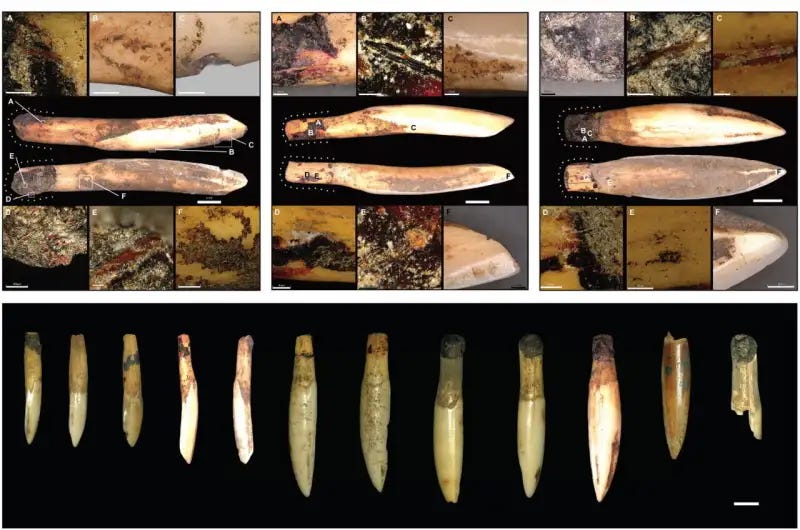
That observation, plus the identification of an unambiguous bone point, forced a reassessment. Every tooth and jaw fragment from the excavation went back under inspection. Ten teeth showed clear macroscopic resin. Two more were flagged as possible. Twelve in total, and Lynley Wallis and her colleagues have now published the analysis in Australian Archaeology.1
All twelve are mandibular incisors. Six come from agile wallabies (Notamacropus agilis), three from spectacled hare wallabies (Lagorchestes conspicillatus), two from northern nail-tail wallabies (Onychogalea unguifera), and one is too broken to identify with confidence, though its width points to N. agilis as well. All three species live in the country around the shelter today. All three are represented in the gnawed bone assemblage. The most economical explanation is that whoever made these objects picked the teeth out of the debris already lying on the shelter floor, which is a strange and rather intimate image: someone sorting through the leavings of dingo meals for the right sort of tooth.
Radiocarbon dating went directly to the resin on two specimens, returning ages of roughly 1,170 to 1,290 calibrated years before present. That detail is worth pausing on. Nearly every comparable ornament from Australia comes from a burial and is dated by proxy, from the age of the human remains rather than the object. These two resin balls were dated as themselves.


