
Anthropology.net
Evolutionary Insights by Anthropology.net
What Ancient Teeth Remember
0:00
-14:40

Paid episode

The full episode is only available to paid subscribers of Anthropology.net

What Ancient Teeth Remember

How Iron Age Italians carried childhood stress and daily meals in their smiles

Teeth are quiet witnesses. They form early, endure long after soft tissues decay, and lock away chemical and microscopic traces of how a person grew up and what they ate. In a new study from Pontecagnano in southern Italy, archaeologists used teeth to tell a story that unfolds over a lifetime, not just at death.
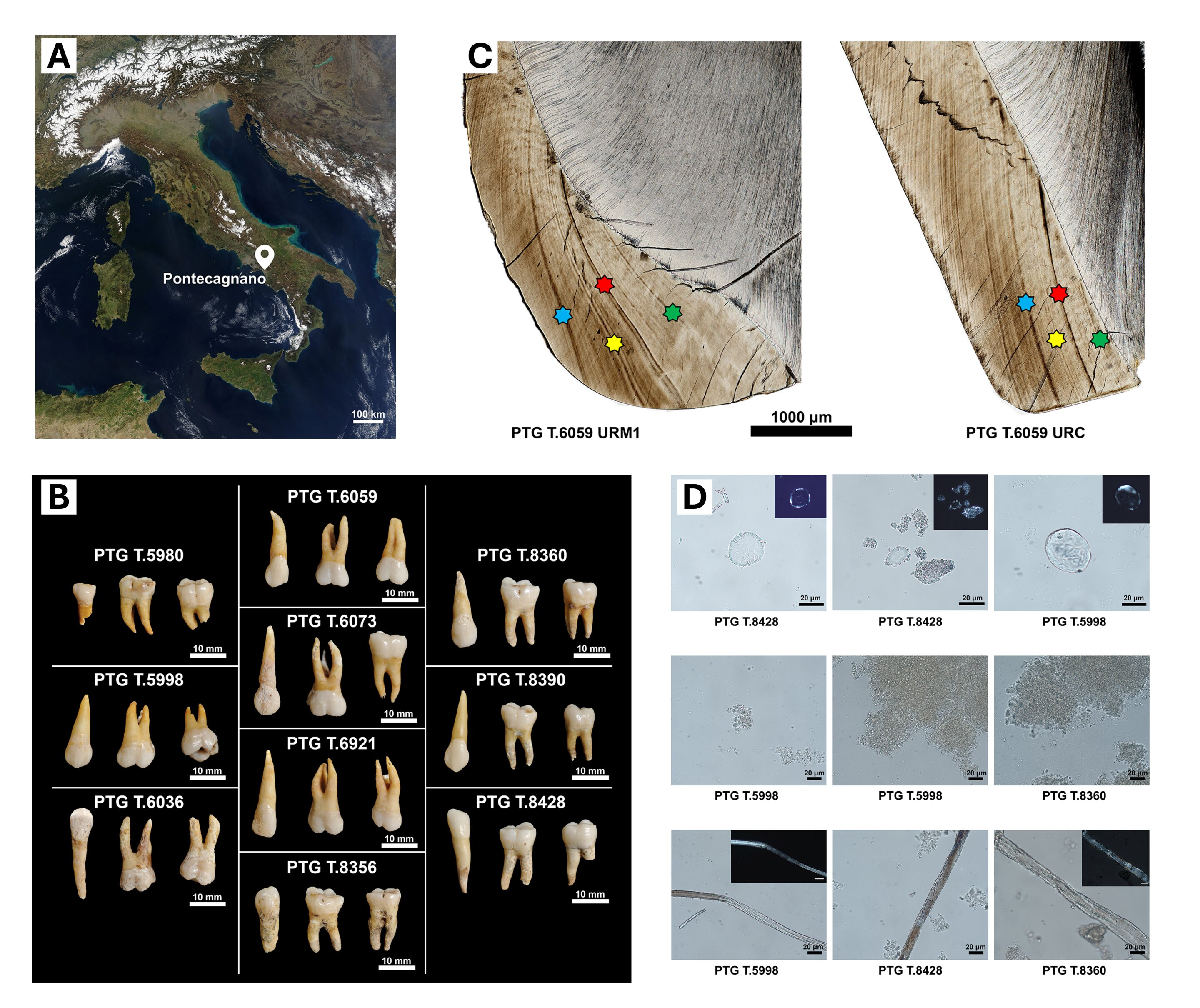
A: Location of Pontecagnano (modified from NASA Visible Earth project ‒ credits to Jacques Descloitres, MODIS Rapid Response Team, NASA/GSFC). B: Dental sample. C: Histological images of two sampled teeth with matched stress Accentuated Lines. D: Microscopic images of the remains extracted from dental calculus. Credit: Germano et al., 2026, PLOS One, CC-BY 4.0 (creativecommons.org/licenses/by/4.0/)

Published in PLOS One,1 the research by Roberto Germano and colleagues reconstructs childhood stress, adult diet, and everyday resilience in an Iron Age community that lived nearly 2,700 years ago. What emerges is not a grand historical narrative, but something more intimate. A glimpse of individual lives shaped by food, illness, and change.

User's avatar

Continue reading this post for free, courtesy of Anthropology & Primatology.