

Dental calculus is not a promising artifact on its face. It is mineralized plaque, the hardened residue of a mouth’s daily microbial activity, and it accumulates on teeth the way lime scale accumulates on pipes. But inside that grayish crust, something remarkable happens: DNA gets trapped. The microorganisms that lived in a person’s mouth at the time of their death are preserved there, sometimes for centuries, in enough quantity and integrity to sequence.
A team led by researchers at Toho University and the University of Tokyo has now done exactly that for a substantial collection of skeletal remains drawn primarily from Edo-period Japan (1603–1868), comparing the results against modern Japanese dental calculus and previously published samples reaching back to the Final Jomon period, around 1000 BCE. The study, published in Scientific Reports,1 recovered oral microbial DNA from 118 ancient individuals excavated from sites across Tokyo, Saitama, Yamanashi, Fukuoka, and Okinawa. What they found complicates any simple narrative about the deep stability of human-associated microbes. The oral microbiome, it turns out, has been changing alongside us — shaped not only by diet and disease, but by the particular texture of historical circumstance, including practices we would not normally think of as biological at all.
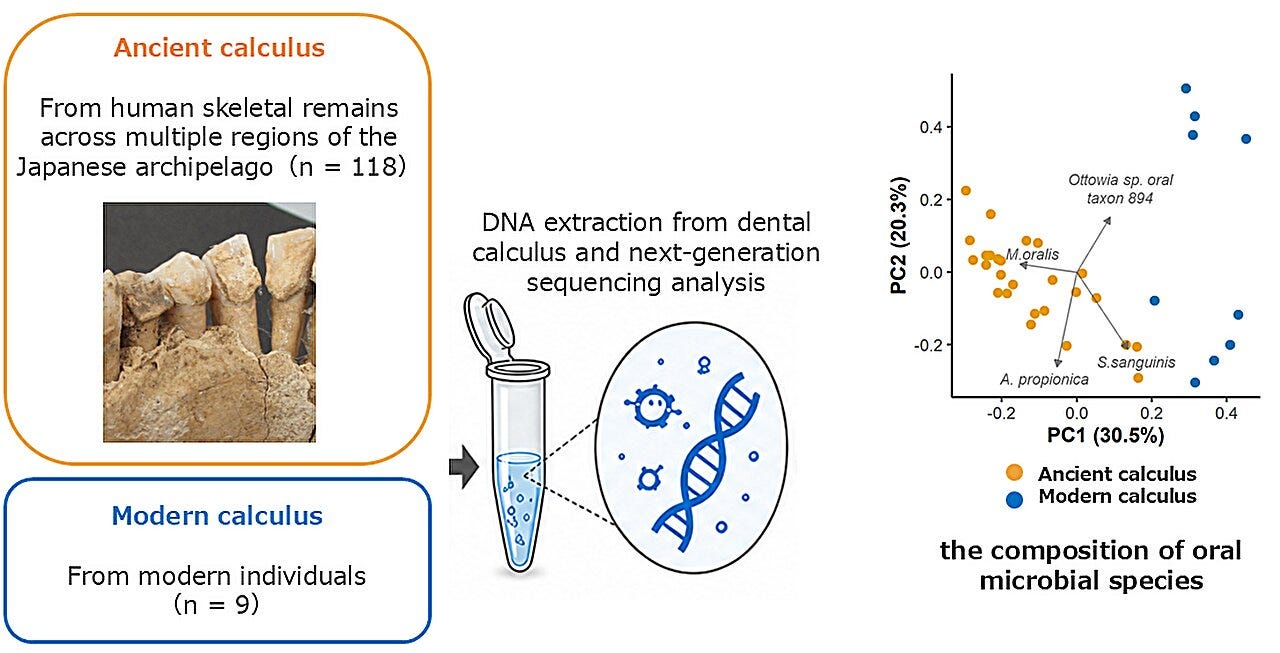
The most striking of those practices involves an archaea called Methanobrevibacter oralis.


