
The molar of a straight-tusked elephant is a remarkable object. It can be larger than a human skull, its enamel ridges worn into washboard patterns by decades of grinding coarse vegetation. Embedded in that enamel, laid down incrementally as the tooth grew, is a chemical record of everywhere the animal went, every watershed it drank from, every forest floor it foraged across. The record is encoded in strontium isotope ratios, which vary predictably with the age and composition of the bedrock underlying different parts of the landscape. Drink water in one geological province for long enough and the strontium in your bones and teeth will reflect it. Move somewhere else and the ratio shifts.
Armaroli, Lugli, and colleagues took four molars from Palaeoloxodon antiquus individuals recovered from Neumark-Nord, a remarkable site in Saxony-Anhalt, northeastern Germany, and read them like diaries. The enamel in a proboscidean molar forms over roughly eight to ten years. Laser ablation along the growth axis samples that entire span at subseasonal resolution, a continuous geochemical autobiography from adolescence through adulthood. What the team found, published in Science Advances1 in March 2026, suggests that at least two of the four animals spent years roaming a landscape very different from the lowland lake country where they ultimately died.
Neumark-Nord dates to the Last Interglacial, approximately 125,000 years ago, during the Eemian warm period. The site preserves the remains of more than 70 Palaeoloxodon antiquus individuals, the largest known fossil assemblage of this species worldwide. These were not animals that wandered in and died of old age. The distribution of cut marks on the bones, and the age and sex structure of the assemblage, skewed heavily toward adult males, constitute what researchers describe as the earliest unambiguous evidence of selective elephant hunting. Neanderthals were working this lakeside landscape almost continuously for around 2,500 years during the early Eemian. They knew what they were doing.
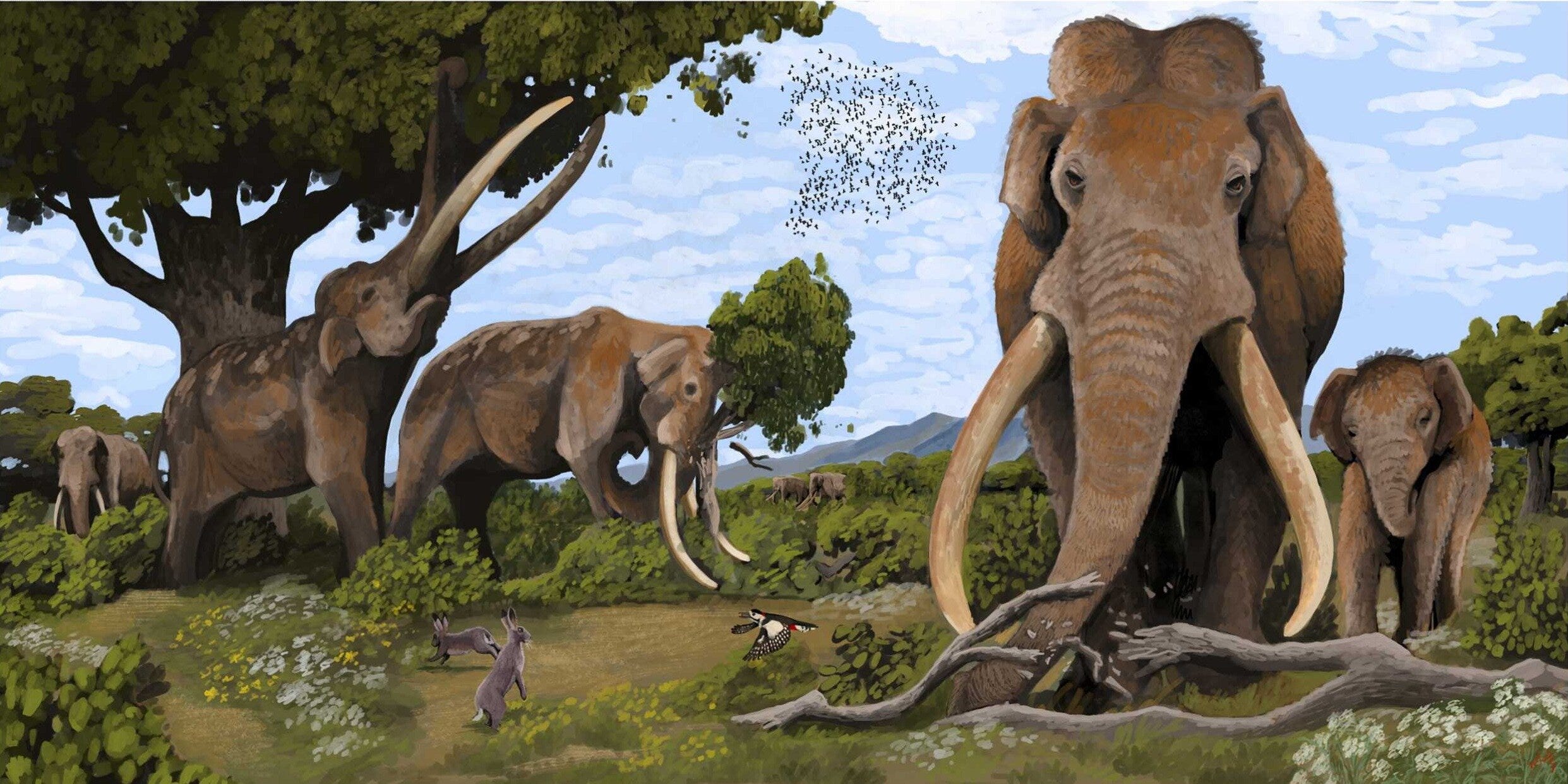
Palaeoloxodon antiquus was not a mammoth. Genetically it was more closely related to the African forest elephant (Loxodonta cyclotis) than to the woolly mammoth, and like forest elephants it was primarily a woodland species, occurring mostly in interglacial settings across Europe. Adult males reached up to four meters at the shoulder and could weigh thirteen tons, surpassing both extant elephant species and woolly mammoths. Estimates suggest that butchering and processing a single individual would have taken a group of 25 people three to five days, yielding enough food to sustain that group for months. Whatever was happening at Neumark-Nord, it was not opportunistic scavenging.


