
On 3 March 2022, seven days after Russia’s full-scale invasion began, soldiers from the 55th Mountain Motorised Rifle Brigade arrived in Yahidne. The village sits roughly 120 kilometres northeast of Kyiv and 15 kilometres south of Chernihiv, on the eastern bank of the Desna River. The brigade was normally garrisoned in Kyzyl, in the Tuva Republic — more than 4,200 kilometres away. Within days of their arrival, the soldiers had fortified the primary school as a command centre and driven approximately 368 civilians, including 69 children, into the building’s basement. The youngest prisoner was a 1.5-month-old infant. The oldest was 93.
They stayed for 27 days.
The basement comprised seven chambers and a corridor, totalling around 200 square metres. There were no functioning toilets, no clean water, no adequate food. The space was damp. Ventilation was poor. There was no room to lie flat, so people slept sitting on chairs or on the concrete floor, which had been covered in cardboard for minimal insulation. Elderly detainees began dying from exhaustion and the absence of medical care. At first, Russian soldiers refused to allow the removal of the bodies, so the living remained alongside the dead in that confined space. Eventually some of the deceased were moved to the boiler building or buried hastily outside.
Russian forces withdrew on 30 March. Ukrainian troops arrived the following day. During those 27 days, 10 civilians died in the basement. Between 17 and 19 others were killed elsewhere in the village — the exact number remains under investigation.
What they left behind is the subject of a study published this month in Antiquity1 by Grzegorz Kiarszys of Szczecin University and Marek Lemiesz of the National Institute of Cultural Heritage of Poland. Their paper applies the framework of contemporary archaeology to the material traces of the Yahidne crime scene: the objects, the wall markings, the satellite record, the damaged structure. The result is something that sits at a genuinely uncomfortable intersection — between forensics, heritage studies, and the philosophy of memory.
What a satellite sees, and what it misses
In March 2022, obtaining commercial satellite imagery of the Yahidne area was not straightforward. Military conflict restricted access to most coverage. Kiarszys and Lemiesz were able to work with two Maxar images available through Google Earth: one from 18 March 2022 (WorldView-3, ground resolution 300mm), one from 22 March (WorldView-2, 500mm resolution).
The 18 March image is strange to look at, once you know what you’re looking for. Heavy vehicle tracks are pressed deep into the arable fields at the centre of the settlement, indicating the prolonged presence of armoured machinery. Artillery craters mark the surrounding fields. Smoke rises from multiple points. Near the school, foxholes are aligned along the main road, and military vehicles cluster around the building. In one corner of the image, the elongated shadows of a group of Russian soldiers fall across the ground near the school’s rear entrance.
The civilians are completely absent from the image. They are directly below, underground.
Four days later, the second image shows fresh damage. The school’s roof and eastern facade have sustained direct rocket strikes. Other buildings previously occupied by soldiers have been destroyed, vehicles burned out and left in place.
The authors draw on Roland Barthes’s description of photography as a kind of clock for seeing — a mechanism that connects the present with something that no longer exists. Satellite imagery, they argue, can function in much the same way. It fixes a moment in time with apparent precision while the most significant thing in the frame is invisible: 368 people in a basement beneath those elongated shadows, 368 people who do not appear in any pixel. The image shows the occupation perfectly. It cannot show the prisoners at all.
What they drew on the walls
After the village was liberated, Ukrainian criminal investigators examined the school. DNA samples collected from the site have since contributed to identifying perpetrators. Personal documents belonging to nine Tuvan soldiers were recovered from the upper floors. In November 2023, selected objects from both the civilian prisoners and the Russian soldiers were catalogued and secured by the Chernihiv Regional Historical Museum. Between late November and early December 2023, the National Institute of Cultural Heritage of Poland coordinated a project to digitally document the school building using LiDAR scanning, photogrammetric modelling of interior features, and CAD plans.
By the time Kiarszys and Lemiesz were conducting fieldwork through multiple visits from December 2022 to March 2025, the basement still held much of what had been left behind. School furnishings remained scattered through the chambers: chairs, ping-pong tables, desks, doors that had been repurposed as makeshift beds. Children’s beds brought down from the nursery upstairs were still there. The concrete floor still bore the imprint of cardboard laid down for insulation.
Among the objects: clothing, plastic bags, cups, remnants of military rations, jars of pickled cucumbers that soldiers had distributed. Schoolbooks, both Russian and Ukrainian language texts and Ukrainian history books for children. Abandoned toys, plastic and cuddly. Copies of Komsomolskaya Pravda — a special edition distributed by Russian forces, which announced a swift victory that never arrived and claimed that Ukrainian civilians were welcoming the invasion.
Upstairs, in the rooms the soldiers had used, more jars of preserved vegetables, many bearing expiration dates from 2012 and 2014. Empty ration boxes, cigarette butts. Walls marked with unit names, nicknames, crude diagrams of observation zones and fields of fire, and hostile inscriptions aimed at Ukrainian opponents. The classrooms had been left heavily damaged and littered.
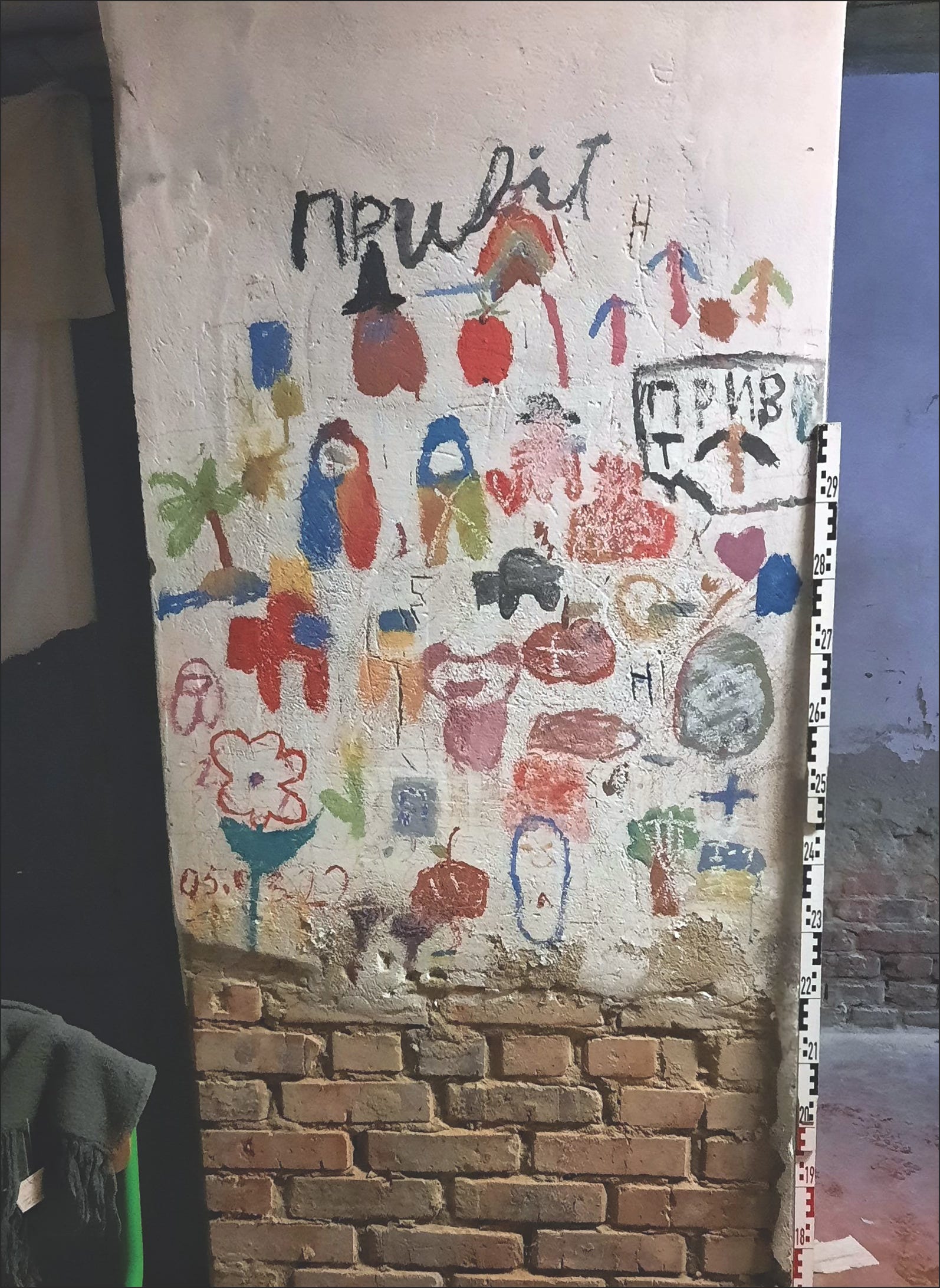
What draws the most sustained attention in the paper is the children’s drawings on the basement walls. Someone had found crayons and paints, and the children drew. The imagery is exactly what you would expect from children who had not yet fully processed where they were or why: characters from the video game Among Us, Minecraft pickaxes, colourful flowers, butterflies, the sun, clouds, trees, Ukrainian flags, fantastical figures. In rooms without paint, charcoal was used instead — scenes of a football match, buildings, a meteor on a collision course with a grocery store. On one corridor wall, someone scratched a scene of two figures hunting a mammoth with a spear, accompanied by a wolf howling at the moon.
Above one cluster of drawings, the word “Hello” is written in Ukrainian. Above another, “No Exit.” Elsewhere, a child wrote: “Mommy, when will you buy me a phone?” Words from the Ukrainian national anthem appear, and other inscriptions now partly faded or illegible.
What is absent from all these drawings is as significant as what is present. Across the entire visual record left by the children, there is no depiction of the soldiers. No weapons, no violence, no acknowledgment of the foreign men occupying the floors directly above. The absence is total. Whether this reflects deliberate avoidance, protective instinct, or simply the way children’s imaginations work under extreme stress, the study does not speculate. But the authors note it carefully: the omission draws attention to itself.
The adult inscriptions followed a different logic. Most were calendars. Drawn on walls in several rooms in varying forms, they tracked the days of imprisonment. The most striking appears on a door in one of the smaller chambers. It starts on 4 March, with certain dates underlined for unknown reasons. On 30 March — the day Russian forces withdrew — the calendar ends. On the following day, someone returned to that door and added a phrase in Ukrainian: “ours have come.” On the wall to the right of the door, someone had listed the dates and surnames of those who died in the basement. On the left, the names of those killed elsewhere in the village. The prisoners could only account for 17 of the 27 to 29 victims — the basement was sealed, and what happened above ground remained largely unknown to them.
Hauntology and the question of what to do with the recent past
The theoretical framework Kiarszys and Lemiesz bring to this material is Derridean hauntology, drawn from Jacques Derrida’s Spectres of Marx (1993, published in English translation in 2006). The concept, broadly stated, holds that presence is always haunted by absence: by futures that never arrived and pasts that never fully disappeared. A spectre, in this framework, arises from unresolved past events — it returns uninvited, disrupts chronological continuity, and refuses to be definitively located in either the past or the present. Derrida tied this to Freud’s notion of the uncanny: the spectre reveals the strange within the familiar.
It’s worth being clear about why this framework does real work here rather than serving as decorative theory. The problem the authors are grappling with is actually quite specific: what makes a mass-produced object — a jar of pickled cucumbers, a cuddly toy, a door with dates written on it — different from an almost identical object that has no association with atrocity? The standard archaeological answer points to context. The object derives meaning from the circumstances of its discovery, from collective memory, from emotional resonance. But that answer, the authors argue, describes the phenomenon without explaining it. It acknowledges that place and memory and meaning co-occur without accounting for the mechanism.
Hauntology offers something more: the idea that material objects from sites of unresolved violence become conduits for the spectre. They do not merely represent the past. They carry the past into the present in a way that resists resolution, that insists on being acknowledged. The comb recovered from a concentration camp is not more culturally significant than any other comb because of what it symbolises. It is more significant because the past it participates in has not been resolved, because the loss it points toward has not been adequately mourned, because justice for the harm has not arrived.
By this reasoning, the material record of Yahidne — the calendars, the drawings, the propaganda newspapers, the jars, the charcoal hunting scene on the corridor wall — is not evidence in the narrow forensic sense, though it is that too. It is also something that continues to do cultural work, that keeps the events present in a way that cannot be fully archived or put away.
The local community in Yahidne decided after the liberation that the school would never again function as a school. That decision had already been made before any archaeological work began. A memorial now stands at the back of the building, near the basement doors that still carry red lettering reading “Warning. Children.” Plans are underway to convert the building into a museum. An architectural proposal has already been developed, though residents have pushed back on the initial concept, insisting on active participation in shaping what the memorial will become.
The digital documentation produced by Kiarszys and Lemiesz — the LiDAR scans, the photogrammetric models, the photographic record — was conducted in part precisely because renovation will alter the building, and renovation will erase things. Selected objects from the basement have already been displayed in Ukrainian museum exhibitions and internationally. The door with the calendar and the names of the dead has been shown outside Ukraine. The photographs of the wall drawings have circulated further still.
What happens when a crime scene becomes heritage is not a question the discipline of archaeology has a settled answer to. Heritage is usually treated as a given, as something that exists in the world to be recognised and managed. Yahidne raises the prior question of how it comes into being — the process by which objects and places that are barely three years old acquire the kind of cultural gravity that would normally attach to things measured in centuries. The hauntology framework, whatever its limitations, at least takes that question seriously. The spectre is not the past preserved. It is the past that refuses to stay still.
Further Reading
Davis, C. 2013. État présent: hauntology, spectres and phantoms, in M. del Pilar Blanco & E. Peeren (ed.) The Spectralities Reader: ghosts and haunting in contemporary cultural theory: 53–60. London: Bloomsbury.
Domashchenko, I. 2023. Yahidne: court hears villagers’ testimony. Institute for War & Peace Reporting, 26 September 2023. https://iwpr.net/global-voices/yahidne-court-hears-villagers-testimony
Oslavska, S. 2023. Inside the basement where an entire Ukrainian village spent a harrowing month in captivity. Time, 15 February 2023. https://time.com/6255183/ukraine-basement-yahidne-held-captive/
Kiarszys, G. & Lemiesz, M. 2026. Spectres of violence: contemporary archaeology of the Yahidne war crime. Antiquity100(411). https://doi.org/10.15184/aqy.2026.10322


