
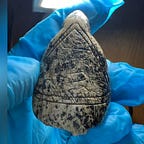
Sometime in 1912 or 1913, excavators at Mizyn, a village on the Desna River in northern Ukraine, found three small ivory carvings of the kind usually called Venus figurines lying beneath a mammoth skull, or possibly inside it; the records are too thin to say which. The skull belonged to one of the site’s circular settings of mammoth bone, generally read as the remains of dwellings, and the carvings were themselves mammoth ivory, so whoever left them there put pieces of a mammoth back with a mammoth. A study published September 11 in npj Heritage Science1 2 argues that the carvers had already worked the tusk itself into their designs.
Mizyn, which older literature often spells Mezin, has yielded 18 of these figurines, the largest group of female figures from Eastern Europe after the Last Glacial Maximum, the coldest stretch of the last Ice Age. Thirteen have a figure engraved on the front, narrow cuts sketching a neck, shoulders, arms, and a triangle long read as pubic, and 11 carry meanders and rows of parallel zigzags on the back and sides. Anyone familiar with Paleolithic art would sort those two kinds of marking without much thought: the front is a picture of a person, and the back is the abstract part, pattern for its own sake or a lost symbol. Simon Radchenko of the Museum of Archaeology at the University of Stavanger in Norway, the study’s first author, and five colleagues argue that the back is the more literal of the two, because its zigzags and meanders copy structures inside the tusk.
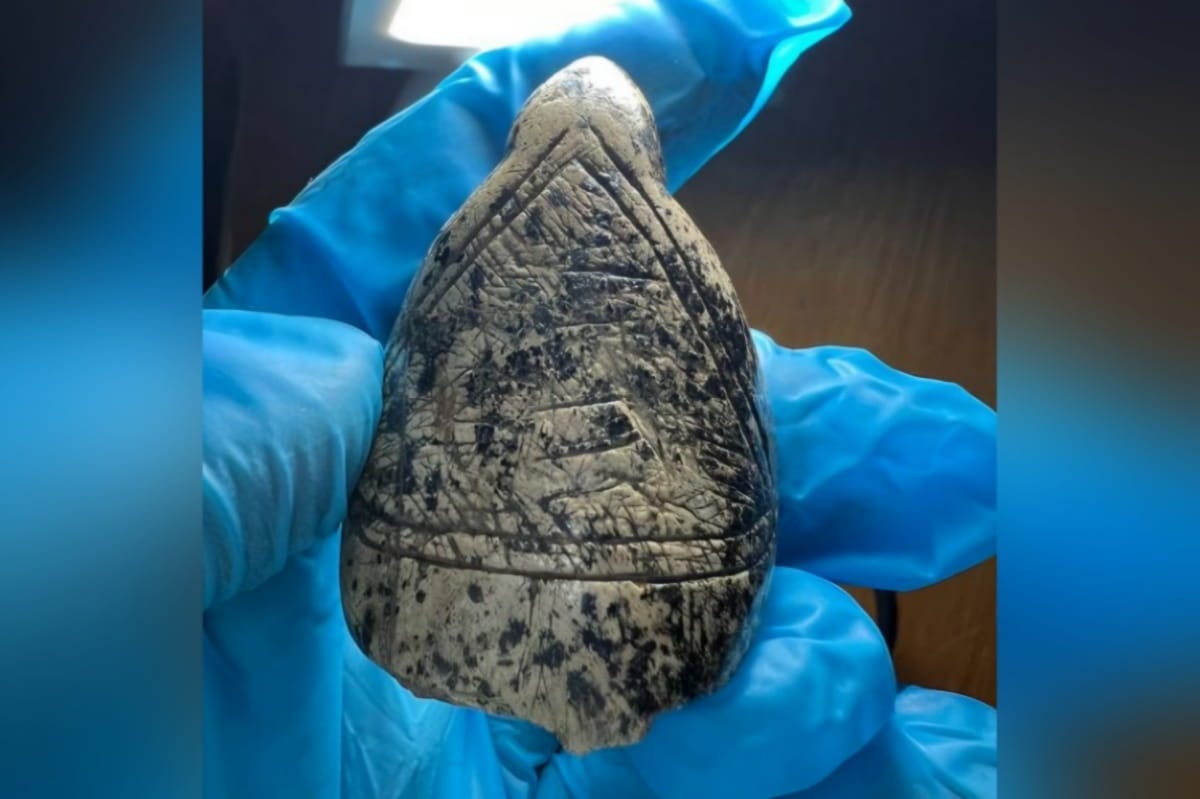
Owen’s lines are the tusk’s growth layers, visible on a crosswise cut as concentric rings around the central nerve channel, much like the rings of a tree. Schreger lines cross those rings at an angle and form a crosshatch that ivory specialists also call engine turning or stacked chevrons. Both show best on a clean break or a polished face, and both run through the tusks of the woolly mammoth, Mammuthus primigenius, as they do through elephant tusks.
Schreger lines differ enough between species to matter for wildlife enforcement. Near a tusk’s outer surface they meet at acute angles, under 90 degrees, in mammoth ivory, and at obtuse angles, over 115 degrees, in modern elephant ivory, a difference used to police the elephant ivory trade. The U.S. National Fish and Wildlife Forensics Laboratory in Ashland, Oregon, whose research underpins the method, warns against judging from a single angle, so an inspector checking a carved bangle today measures several, reading the same crosshatch the Mizyn carvers chose to reproduce.
European figurines of women, made over more than 30,000 years, mark two thresholds for archaeologists: the first pictures of human bodies, and the later turn toward schematic ones reduced to an outline and a few cuts. That second turn is usually told as a western story ending in the pared-down Gönnersdorf style, which spread through central Europe between about 17,000 and 13,000 years ago. Dmytro Kiosak of the Leibniz-Zentrum für Archäologie in Mainz, a coauthor, has said the results undercut the old idea that Paleolithic art developed along a single track, simple first and elaborate later. If these are among the first schematic figurines made after the Last Glacial Maximum, and their most abstract-looking marks came out of the ivory, then an early step toward abstraction in Europe was taken by people looking hard at a tusk, on surfaces they had polished smooth.


