

Ancient Blueprints in Modern Faces
Every face carries an ancient signature. The slope of a nose, the width of a jaw, the contour of a cheekbone—all emerge from a delicate choreography of genes that turn on and off in early development. But some of these instructions were not written by Homo sapiens alone.
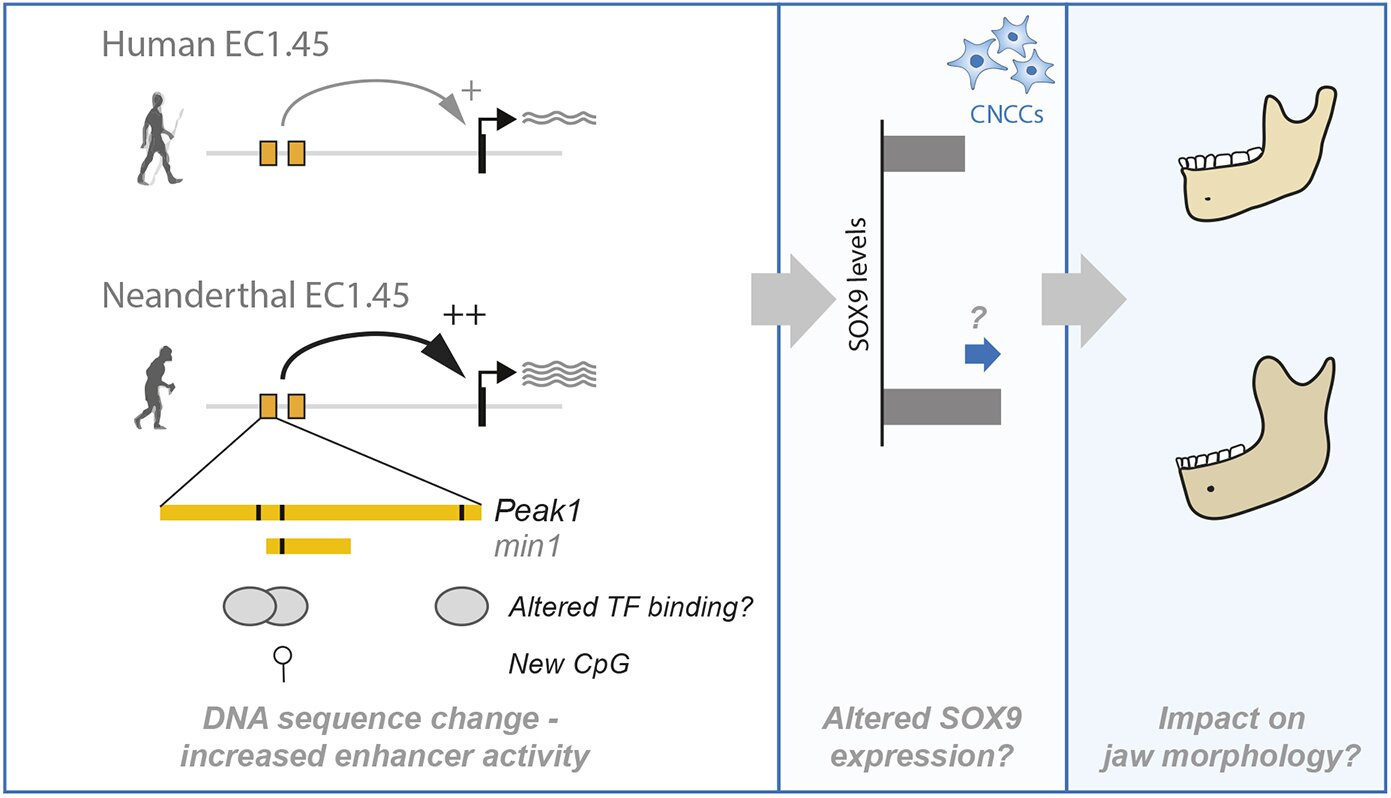
A recent study led by geneticist Hannah Long at the University of Edinburgh reveals that a handful of Neanderthal genetic variants continue to influence how our faces form. Published in Development,1 the research identifies small differences in the Neanderthal version of a DNA enhancer—a regulatory stretch of the genome that controls the activity of a crucial gene, SOX9, responsible for shaping the lower jaw.
In essence, this region of Neanderthal DNA acts like a louder volume knob for the jaw-forming gene. When active, it boosts the signal, leading to more pronounced growth in the tissues that become the mandible.
“These tiny differences illustrate how evolution often works—not through new genes, but through subtle tweaks to when and where existing ones switch on,” explains Dr. Nadia Peralta, a developmental geneticist at the Max Planck Institute for Evolutionary Anthropology. “Regulatory DNA is the invisible scaffolding that determines our anatomy.”
Cranial EC1.45 activity at 2 dpf, focusing on jaw-adjacent signal. Credit: Development (2025). DOI: 10.1242/dev.204779


