

A Fossil That Refused to Sit Still
When Sahelanthropus tchadensis was first described in the early 2000s, it arrived with a skull and a question. Was this strange, flat faced ape an early member of the human lineage or simply an extinct cousin that happened to resemble us?
At roughly seven million years old, Sahelanthropus sits close to the estimated split between humans and chimpanzees. If it walked on two legs, it would push the origin of bipedalism to the very base of our family tree.
For years, the debate hinged on skull anatomy and on fragmentary limb bones whose meaning was hotly contested. A new study in Science Advances1 shifts the discussion from speculation to structure.
Reading Movement in Bone
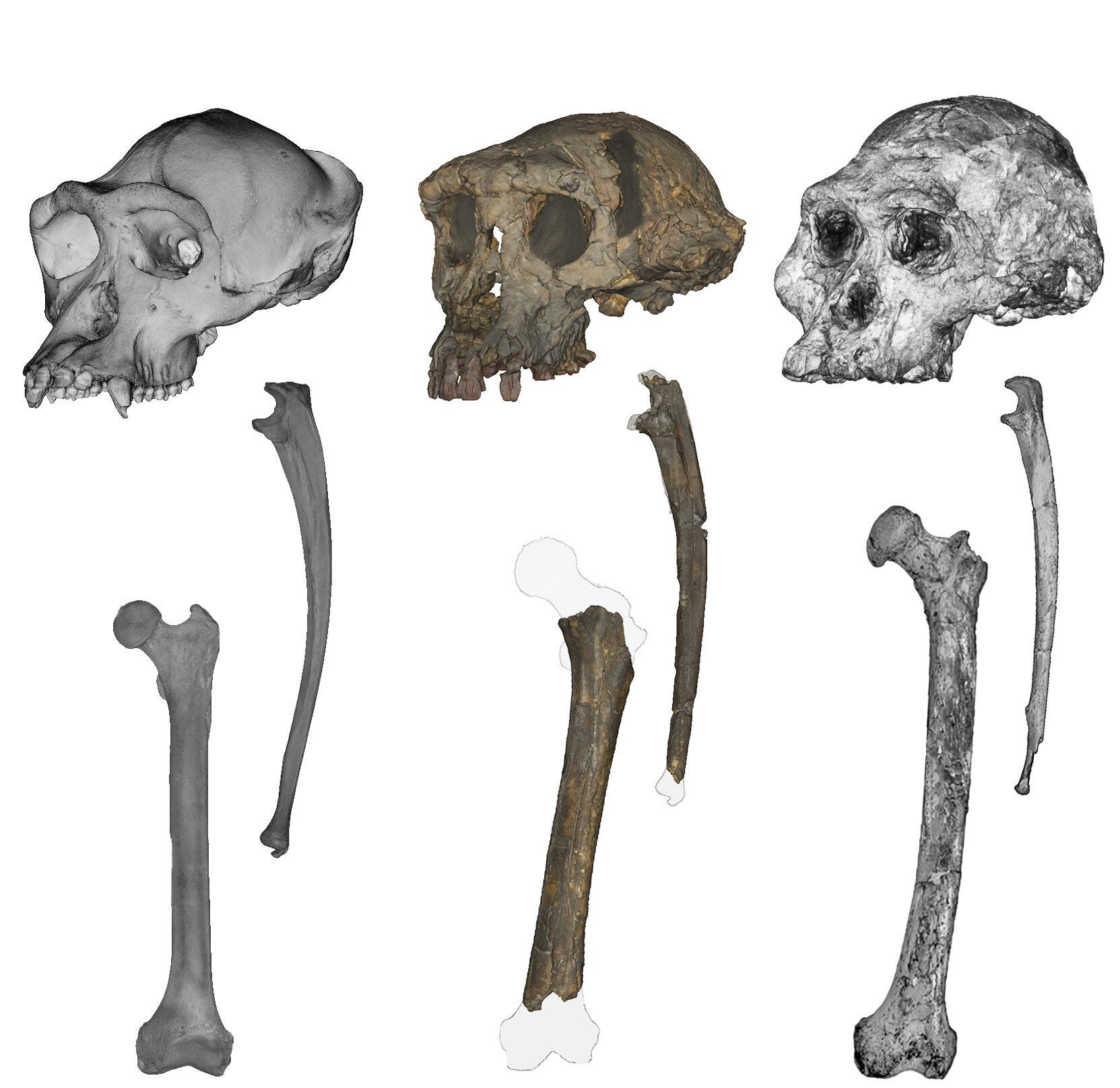
Scott Williams and his colleagues focused on the femur and ulnae of Sahelanthropus, using detailed 3D analyses and comparisons with both living apes and fossil hominins. What they found was a small but decisive feature.
On the femur sits a bump known as the femoral tubercle. In humans and other hominins, it anchors the iliofemoral ligament, the strongest ligament in the body. This ligament stabilizes the hip during upright walking. It has not been identified in non bipedal apes.
The researchers found that Sahelanthropus had one.
“The presence of a femoral tubercle provides direct evidence for habitual bipedalism,” the authors report, noting that this feature is unique to hominins.
This was not the only clue.
A Body Built for Two Worlds
The team confirmed two additional traits linked to upright walking. The first is femoral antetorsion, a natural twist in the thigh bone that helps align the legs for forward motion. The second is the structure of the gluteal muscles, which help keep the pelvis stable while standing and walking.
Together, these features place Sahelanthropus firmly within the range of early hominins like Australopithecus, though it remained distinct from later forms.
The proportions of the limbs tell a similar story. Apes tend to have long arms and short legs. Hominins shift toward longer legs. Sahelanthropus sits in between, with a femur longer than expected for an ape but shorter than in modern Homo sapiens.
Williams describes the animal this way:
“Sahelanthropus tchadensis was essentially a bipedal ape that possessed a chimpanzee sized brain and likely spent a significant portion of its time in trees.”
It walked upright on the ground but still climbed when it needed to.
Rethinking the First Steps
The implication of this work is not that Sahelanthropus looked or moved like a modern human. It did not. Instead, it suggests that bipedalism emerged in a creature that still retained many ape like traits.
This fits with a growing picture of early human evolution as a patchwork. Traits did not appear all at once. Upright walking came before big brains, stone tools, or long distance running.
“Despite its superficial appearance, Sahelanthropus was adapted to using bipedal posture and movement on the ground,” Williams explains.
The earliest steps toward humanity may have been taken by an ape that looked nothing like us from the neck up.
Why This Matters
Bipedalism is often treated as the defining feature of the human lineage. Finding solid evidence for it at seven million years ago reshapes the timeline of our origins.
It suggests that the last common ancestor of humans and chimpanzees may already have been experimenting with upright walking. It also reminds us that evolution does not wait for perfection. It works with what is available.
In the case of Sahelanthropus tchadensis, that meant standing up while still clinging to the trees.
Further Reading
Lovejoy, C. O. 2009. Reexamining human origins in light of Ardipithecus. Science.
Richmond, B. G. and Jungers, W. L. 2008. Orrorin tugenensis femoral morphology. Journal of Human Evolution.
Williams, S. A., Wang, X., Araiza, I., Guerra, J. S., Meyer, M. R., & Spear, J. K. (2026). Earliest evidence of hominin bipedalism in Sahelanthropus tchadensis. Science Advances, 12(1). https://doi.org/10.1126/sciadv.adv0130


