

A Landscape Famous for Stone, and for Movement
Murujuga, on the northwest coast of Western Australia, is often described as a place where stone speaks. Its hills and islands hold one of the densest concentrations of rock art on Earth, alongside vast scatters of stone artefacts that record tens of thousands of years of human presence by Homo sapiens. The surface appears crowded with evidence of ancient lives.
Yet surfaces can mislead.
A team of archaeologists, soil scientists, and geomorphologists working on Middle Gidley Island has shown1 that some of what appears to be an archaeological signal is also a geological one. In clay-rich soils, stone artefacts do not necessarily stay where people left them. They move upward, slowly and persistently, driven by cycles of wetting and drying.
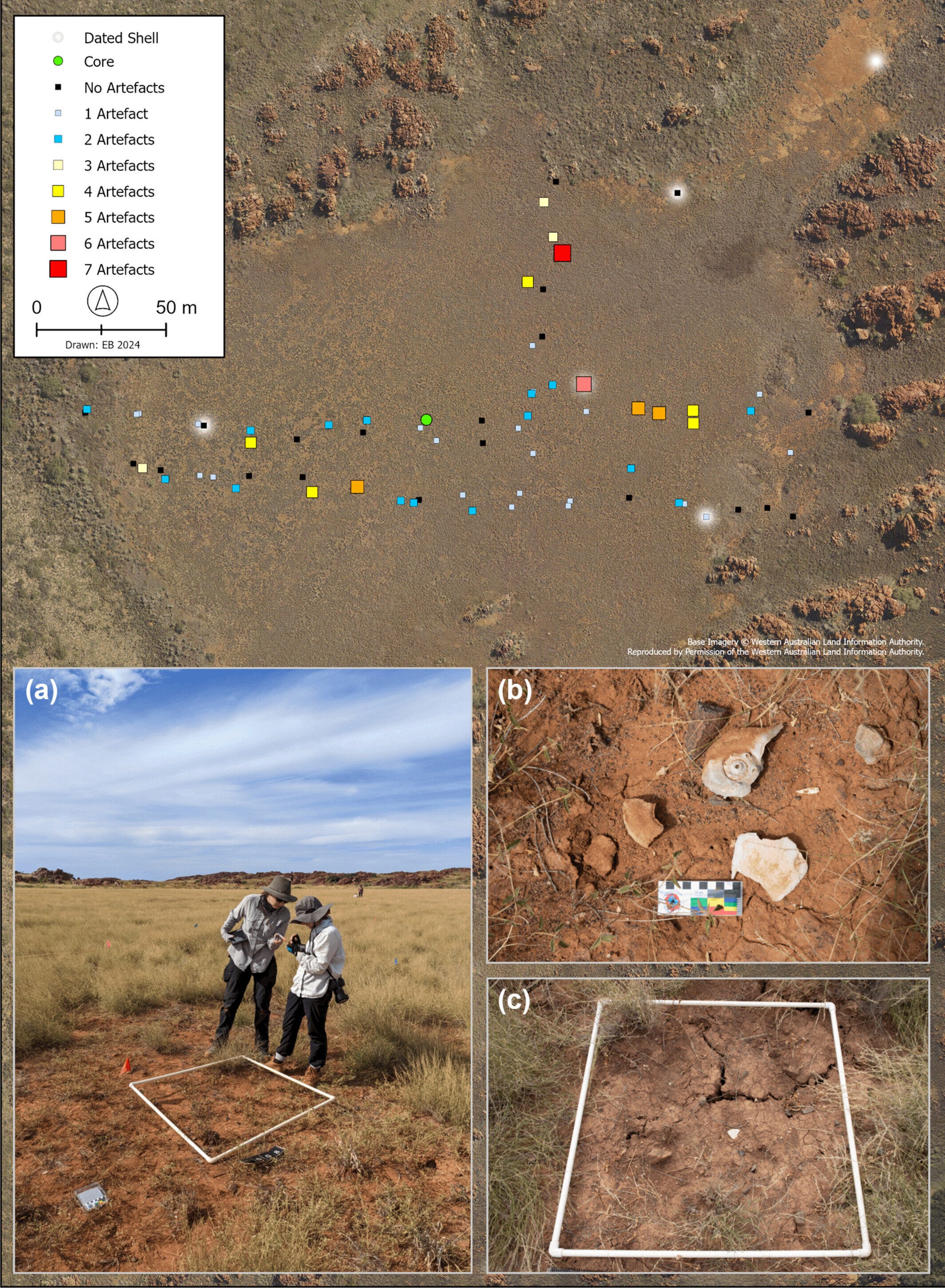
This is not erosion in the dramatic sense. No floods sweeping tools downhill. No burrowing animals stirring the record. Instead, the soil itself breathes.
“Clay soils behave less like stable containers and more like active agents,” explains Dr. Rachel Thompson, a geoarchaeologist at the University of Queensland. “They expand, contract, and rearrange materials without any external disturbance.”


